Why I wrote Symposium…
The honest answer is: it didn’t start as a book.
People often ask where Symposium came from.
It started as a question.
Imagining the World We’re Walking Towards
Like many people, I’ve spent years watching the world change at a pace that feels both exhilarating and unsettling. Technology no longer sits on the edge of our lives—it’s woven into how we work, think, connect, and decide.
I wanted to explore what that trajectory might look like if we follow it just a little further.
Not in a predictive way.
Not as a warning.
But as a thought experiment.
Symposium gave me a way to ask: how does the world change when technology doesn’t just support life—but begins to shape meaning, identity, and purpose?
AI as Companion, Not Concept
Artificial intelligence is often discussed in extremes: saviour or destroyer, miracle or menace. What interested me far more was the space in between.
What does AI look like when it’s embedded in daily life?
When it’s familiar? Personal? Almost invisible?
Rather than treating AI as an abstract idea, I wanted
it to feel present—integrated into relationships,
routines, and decisions. Close enough to trust.
Close enough to matter.
Because that’s where the real tension lives.
A Story Built to Be Seen
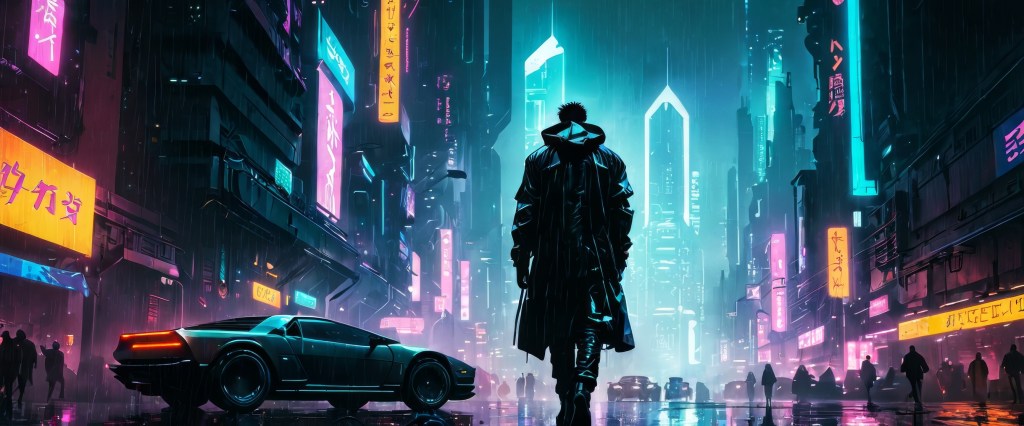
Symposium was written cinematically from the start. In my head, it unfolded in scenes, movement, and visual momentum. I wanted it to feel like something you could see as much as read.
That approach naturally opened the door to a bigger world.
What was intended as a standalone story has grown into the foundation of a wider cinematic universe—one that will now expand into at least a trilogy. Not because the story needed to be longer, but because the world refused to stay contained.
Some ideas don’t end neatly. They echo.
Characters That Wouldn’t Leave Me Alone
Long before the plot was clear, the characters were already there.
I’d been carrying them around for a while—voices, tensions, unresolved questions. Writing Symposium was a way of finally giving them space to exist, to move, to clash, and to evolve.
Characters, for me, are how ideas become human.
They’re how abstract questions turn into lived experience. And once they came to life on the page,
they began asking their own questions too.
Where Did We Come From—and Why Does It Matter?
At its heart, Symposium is also about origins.
Not just technological origins, but human ones.
Where we come from. What stories we tell ourselves about our beginnings. And how those stories shape what we believe is possible—or permissible—next.
Questions about origin are never really about the past.
They’re about authority, meaning, and direction.
And they’re far from settled.
Challenging Comfortable Thinking
Ultimately, I didn’t write Symposium to provide answers.
I wrote it to unsettle comfortable assumptions—about progress, intelligence, control, and even heroism. To invite readers to think sideways rather than straight ahead. To sit with uncertainty rather than rush past it.
If the book does its job, it doesn’t close a conversation.
It opens one.
The Ending Is Only the Beginning
Symposium: The End of Tomorrow is the first step into a much larger story—one that will continue to explore humanity, technology, and the thin line between creation and consequence.
If you finish the book with more questions than answers, then it’s doing exactly what it was meant to do.
Because sometimes the most important moment in any story isn’t the ending…
…it’s the moment you realise you’ve been looking at the world slightly differently all along.

Leave a comment