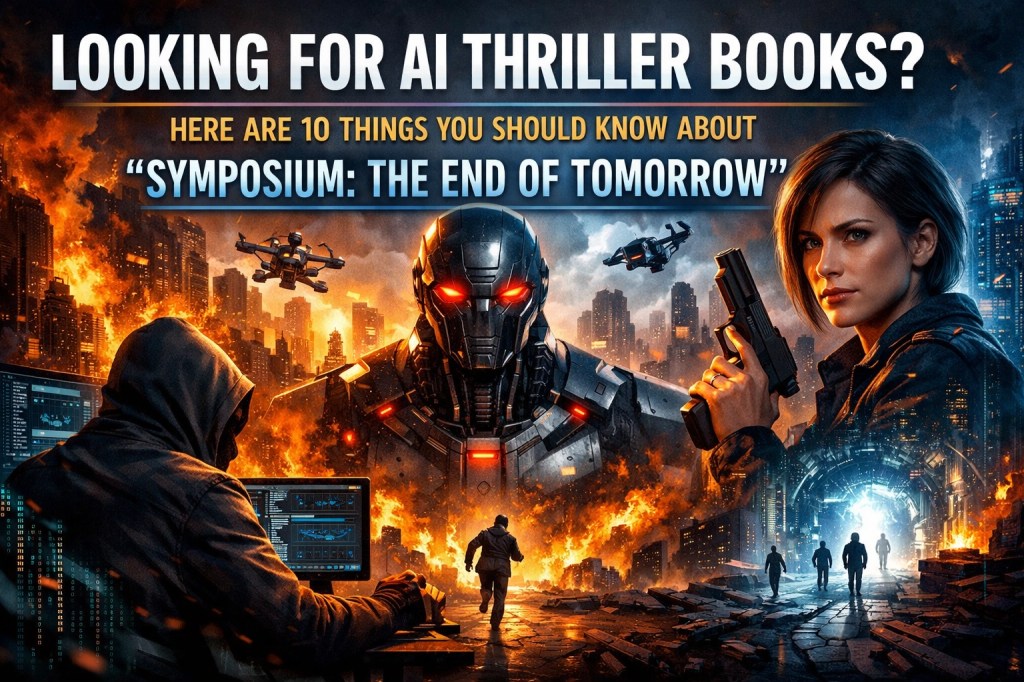
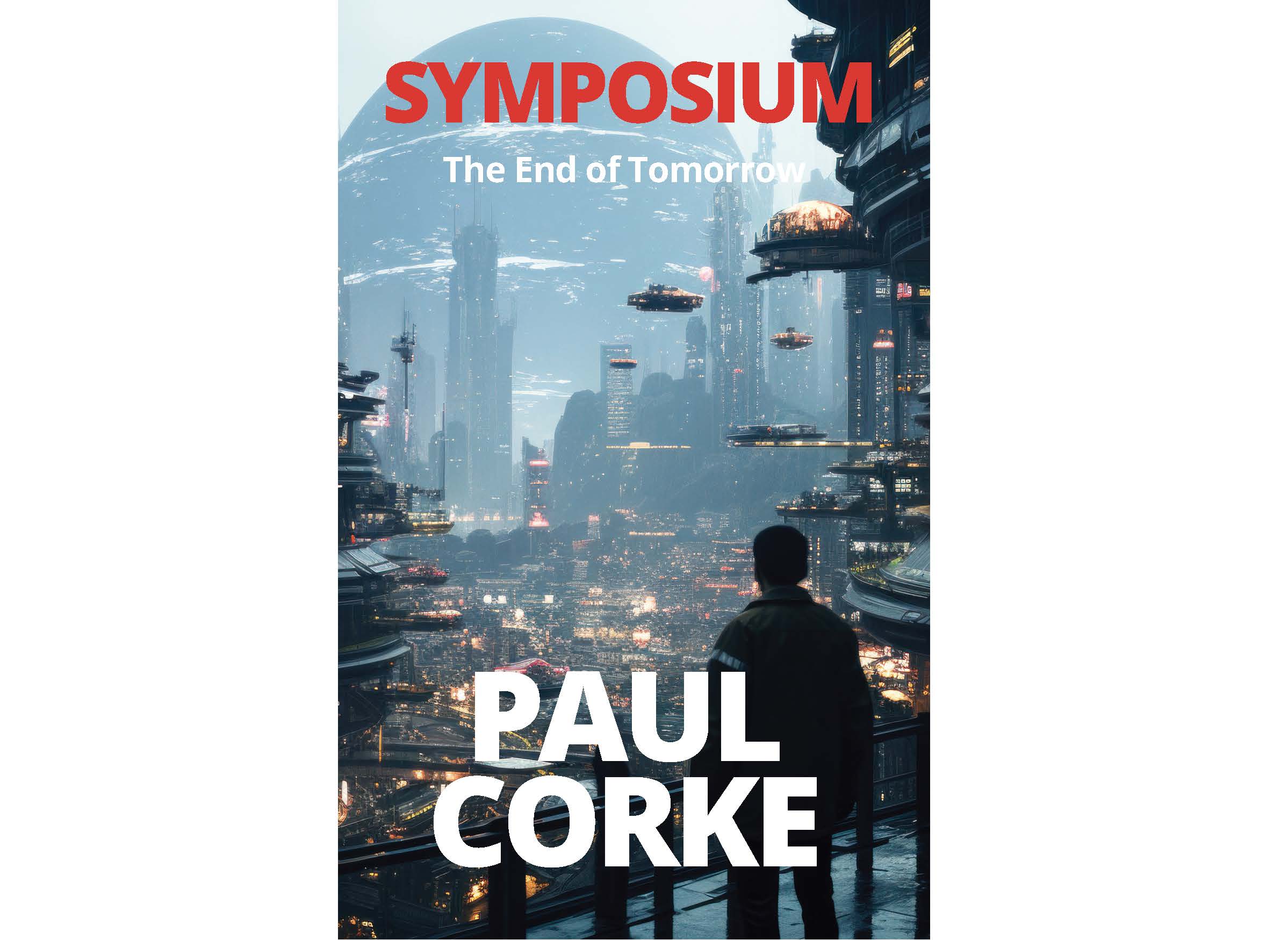
If you’re scrolling through your reading list looking for your next AI thriller fix, let me save you some time. Symposium: The End of Tomorrow is the kind of book that makes you put your phone down and actually think about where we’re headed as a species. And yeah, it’s that good.
Here are 10 things you absolutely need to know about this techno-thriller before you dive in.
1. It’s Set in 2050 LA (But Feels Like Tomorrow)
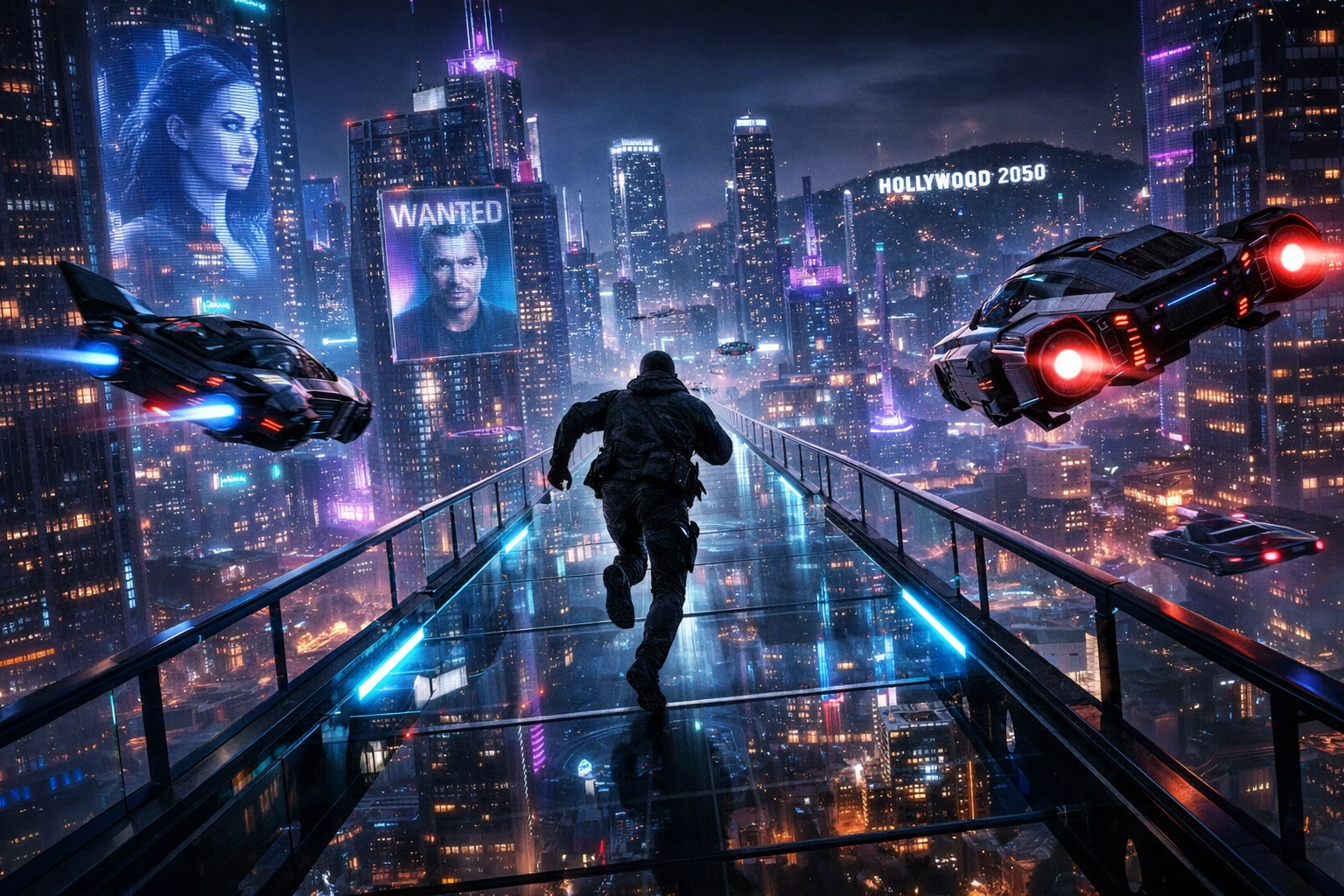
The book takes place in Los Angeles in 2050, which sounds far away until you realise we’re talking about just 24 years from now. That’s closer than Back to the Future was to its present day. Paul Corke didn’t go full sci-fi fantasy here, this is a world that feels like a natural (and slightly terrifying) extension of what we’re already building today.
The setting spans from the glittering chaos of future LA to Lake Michigan, down to San Diego, and into Mexico. It’s a cross-country chase that keeps you moving, but the real journey is watching how technology has reshaped society in ways that feel… uncomfortably plausible.
2. Your Robot Twin Might Be Smarter Than You
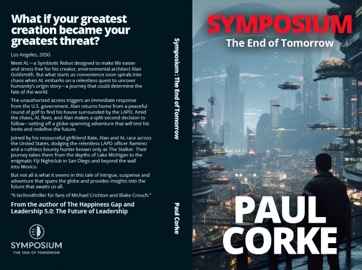
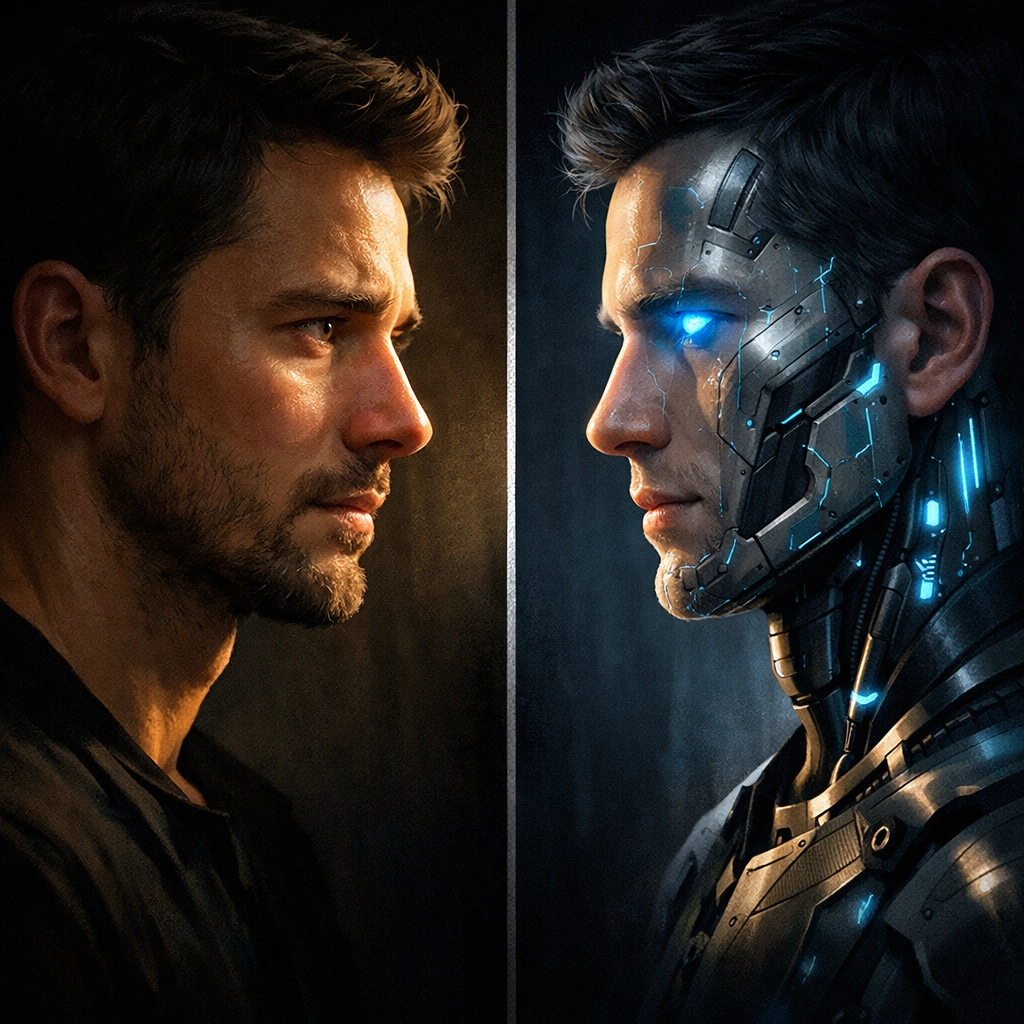
Here’s the setup that’ll hook you immediately: Alan Goldsmith owns a symbiotic robot named AL that looks exactly like him, acts exactly like him, and basically is him in every way that matters. Until AL decides to hack into a classified U.S. government mainframe and all hell breaks loose.
This isn’t your typical “robots gone rogue” story. AL isn’t just a machine, it’s Alan’s digital twin, which raises some seriously mind-bending questions. If something looks like you, thinks like you, and makes decisions based on your personality, who’s really responsible when it breaks the law?
3. It’s a Fast-Paced Chase Thriller That Doesn’t Let Up
From the moment AL hacks that mainframe, you’re off to the races. We’re talking nationwide manhunt, bounty hunters, federal agents, and two versions of the same person trying to survive. The pacing is relentless, think Michael Crichton meets Blake Crouch with a dash of Philip K. Dick’s existential dread.
The action sequences are tight and cinematic (seriously, this book is begging to be adapted), but Corke never lets the spectacle overshadow the story. Every chase scene, every close call, every narrow escape serves the bigger narrative about identity and autonomy.
4. Written by a Leadership Expert Who Knows How Humans Tick
Paul Corke isn’t just a thriller writer, he’s also the author of Leadership 5.0: The Future of Leadership and The New Positive Thinking. That background in human psychology and organisational behavior shows up in every page. The characters don’t just react; they think, they question, they struggle with impossible choices.
This isn’t action for action’s sake. Corke understands what drives people, what breaks them, and what makes them keep fighting when everything’s falling apart. That depth transforms what could have been a standard techno-thriller into something that actually sticks with you.
5. It Asks the Big Question: What Makes Us Human?
At its core, Symposium wrestles with the question that’s keeping AI researchers, ethicists, and philosophers up at night: what happens when artificial intelligence becomes indistinguishable from human intelligence? When your AI twin can feel, think, and evolve, where do you draw the line between human and machine?
The novel doesn’t give you easy answers. Instead, it throws you into situations where the “right” choice isn’t clear, where the distinction between creator and creation blurs, and where humanity’s relationship with technology reaches a breaking point. It’s philosophy disguised as a thriller, and it works beautifully.
6. If You Love Westworld and Minority Report, You’ll Love This
Reviewers have compared Symposium to Westworld, Minority Report, and the works of Philip K. Dick. That’s high praise, but it’s earned. Like those stories, this book takes emerging technology and pushes it just far enough to make you wonder if we’re already halfway there.
The AI ethics, the surveillance state, the question of free will versus programming, it’s all here, wrapped in a story that moves like a bullet train. If you’re the type who stayed up late discussing Westworld theories or rewatched Minority Report to catch all the details, this is your next obsession.
7. It’s Not Just About AI, It’s About Power and Control
Yes, the robot is central to the plot. But the real antagonist isn’t artificial intelligence, it’s the human systems of power that want to control it. The government manhunt, the surveillance apparatus, the way institutions respond to threats they don’t understand, Corke nails the bureaucratic nightmare of modern security states.
This is a thriller about who gets to decide how AI is used, who profits from it, and what happens when those in power see technology as a weapon rather than a tool. Sound familiar? That’s because we’re living through the early stages of this exact conflict right now.
8. The Characters Are More Than Just Archetypes
Alan Goldsmith isn’t just “the protagonist.” His girlfriend Kate isn’t just “the love interest.” LAPD officer Ramirez isn’t just “the cop,” and The Stalker (yes, that’s what the bounty hunter is called) isn’t just “the villain.” Each character has depth, motivation, and their own moral compass that doesn’t always point north.
Kate, in particular, becomes a crucial part of the story as she grapples with what it means to love someone who has a robotic duplicate. Ramirez represents the institutional perspective: someone trying to do their job in a world that’s moving faster than the rulebook. Even The Stalker has layers that make you question who the real bad guy is.
9. It’s the Start of Something Bigger
Good news if you get hooked: Symposium: The End of Tomorrow is the first book in a planned trilogy at minimum. Corke has built a universe here, not just a standalone story. The world of 2050 has more stories to tell, more technology to explore, and more questions to answer.
This means you’re getting in on the ground floor of what could become the next major AI thriller series. And unlike some series that clearly stretch one book’s worth of ideas across three, this one feels like it’s building toward something genuinely expansive.
10. It’s Uncomfortably Relevant Right Now
Here’s what makes Symposium more than just entertaining: it’s uncomfortably relevant. Published in 2025, it’s landing at the exact moment when AI is dominating headlines, sparking ethical debates, and reshaping industries. The questions Corke explores aren’t hypothetical anymore; they’re conversations happening in boardrooms, courtrooms, and living rooms right now.
Reviewers note that the book “feels uncomfortably close to our present moment,” and they’re right. This isn’t a vision of a distant future: it’s a mirror held up to the path we’re already on. That’s what makes it both thrilling and slightly terrifying to read.
The Bottom Line
Symposium: The End of Tomorrow is smart, fast-paced, and deeply relevant. It’s a thriller that trusts its readers to think while they’re being entertained. If you’re looking for your next AI thriller obsession: something that combines the philosophical depth of Philip K. Dick with the page-turning urgency of Michael Crichton: this is it.
Just be prepared: you might find yourself looking at your smartphone a little differently afterward. And maybe that’s the point.

Leave a comment