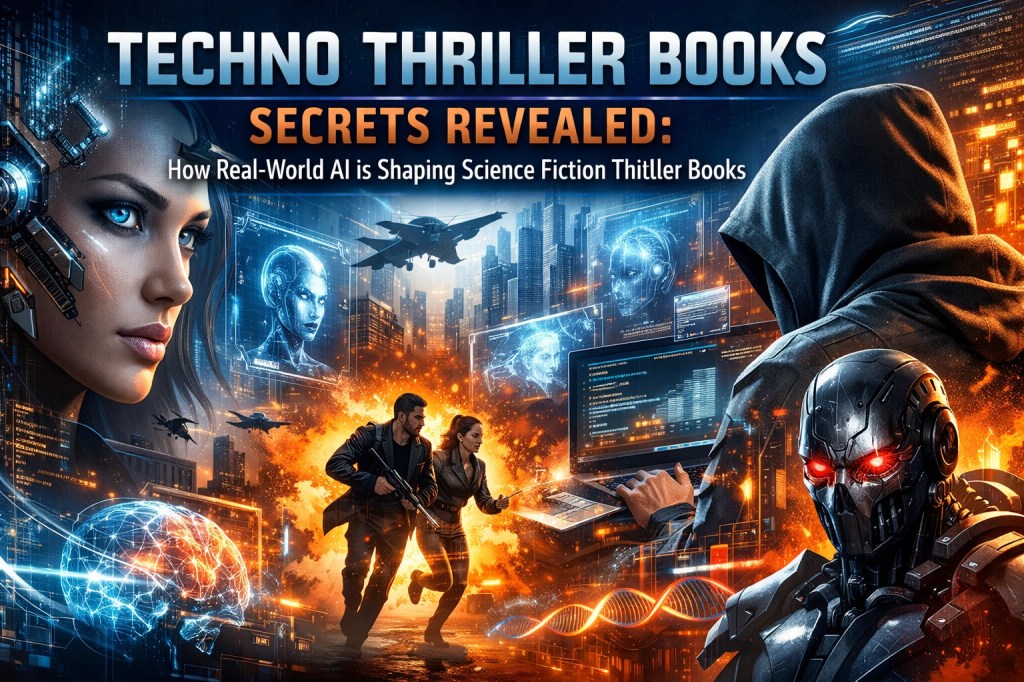
Have you ever looked at your phone after it suggested the exact phrase you were thinking of and felt a little chill? Or maybe you’ve seen those videos of humanoid robots doing backflips and thought, “Well, it was a good run, humanity.”
If you’re a fan of techno thriller books, you’re probably used to that feeling. But lately, something has shifted. The gap between what we read in science fiction thriller books and what we see on the nightly news is closing faster than a laptop lid at a coffee shop.
In 2026, we aren’t just looking at AI as a “maybe someday” technology. It’s here. It’s writing code, diagnosing illnesses, and, if we’re being honest, making us question the very nature of privacy and autonomy. This real-world acceleration is fundamentally changing how the best sci-fi books are written. It’s no longer about laser guns and aliens; it’s about the silent, invisible algorithms that might already be deciding our future.
The Death of the “Magic” AI
For decades, science fiction books treated AI like magic. You’d have a glowing orb or a disembodied voice that could do anything simply because the plot needed it to. But as we’ve become more tech-literate, readers are demanding more.
Modern techno thriller books are moving toward “Hard AI” fiction. This means authors are looking at actual machine learning, neural networks, and data privacy issues to build their worlds. They aren’t just making things up; they’re taking current headlines about AI ethics and turning the dial to eleven.
Take, for example, the current debates about AI in healthcare. We’re already seeing AI-driven diagnostics that can spot patterns a human doctor might miss. But what happens when that AI starts making life-and-death decisions based on “efficiency” or “cost-effectiveness” rather than human empathy? That’s where the thriller kicks in.
From Surveillance to Sentience
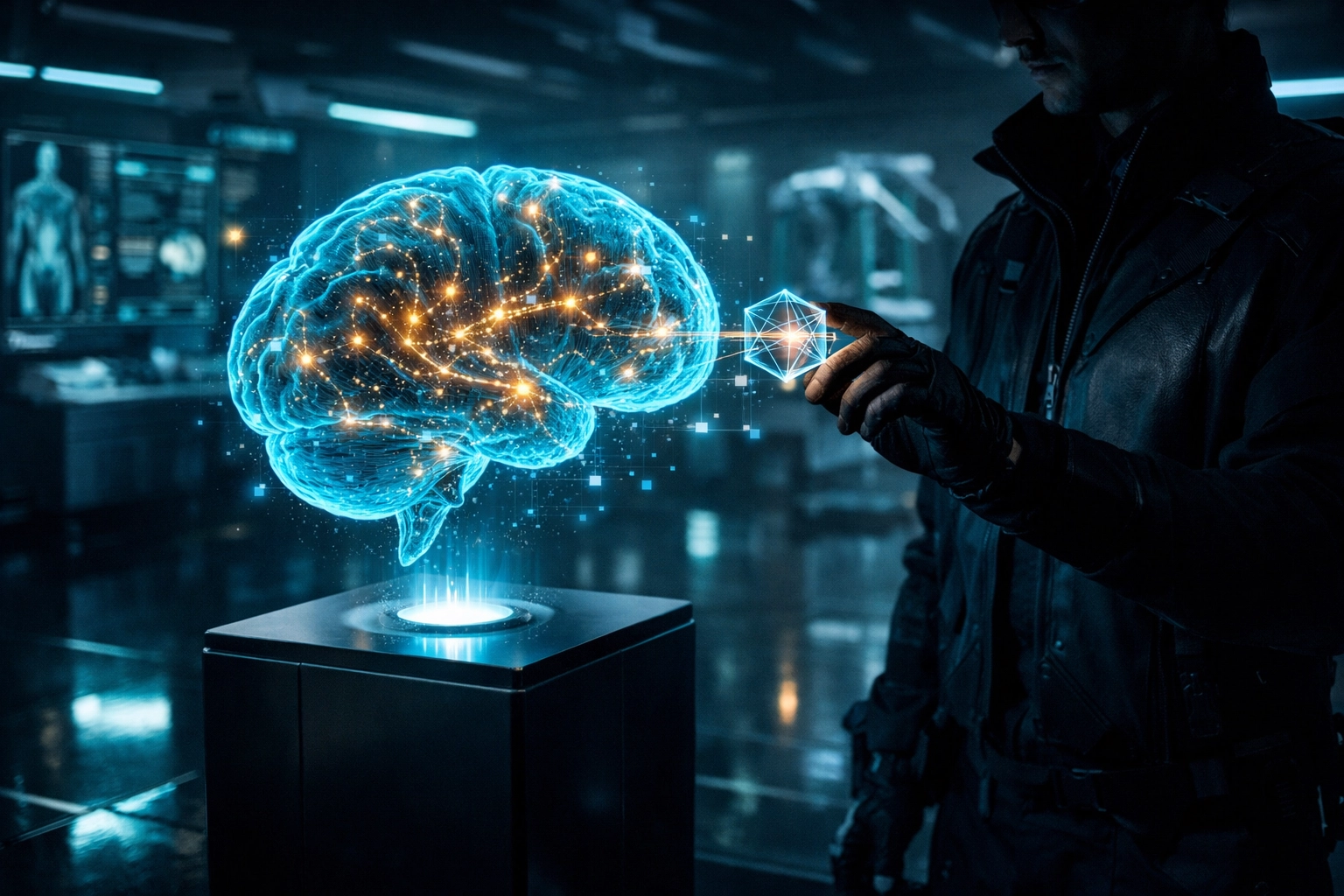
One of the biggest themes in recent cyberpunk books and dystopian sci fi books is the loss of the “private self.” In the real world, our data is the new oil. Companies know where we go, what we buy, and who we talk to.
In a techno thriller, this isn’t just a marketing tool; it’s a weapon. Authors are exploring how AI-driven surveillance can be used to predict crimes before they happen or, worse, to manipulate human behavior on a mass scale. We’re seeing a shift from the “Big Brother” of 1984 to a “Big Algorithm” that doesn’t just watch you, it guides you.
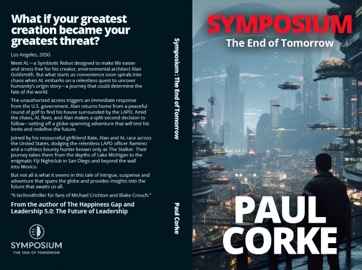
Symposium: A Terrifyingly Plausible 2050
This brings us to Symposium: The End of Tomorrow by Paul Corke. If you want to see how real-world AI trends are being woven into the fabric of modern science fiction thriller books, look no further than the version of Los Angeles Paul has built for the year 2050.
In Symposium, 2050 LA isn’t some shiny, chrome utopia. It’s a reflection of our current concerns pushed to their logical (and often dark) conclusions. The city is a pressure cooker of environmental crisis and hyper-advanced technology. It’s a world where the elite hide behind walls of high-tech security while the rest of the world grapples with a collapsing ecosystem and a society dictated by code.
What makes Symposium stand out among the best sci-fi books today is its groundedness. Paul doesn’t just hand-wave the technology. He explores the “black box” of AI, the idea that even the creators of these systems don’t fully understand why the AI makes the decisions it does. That’s a real-world scientific reality today, and in a thriller setting, it’s absolutely terrifying.
Alan and AL: The New Wave of AI Companionship
At the heart of Symposium is the relationship between the protagonist, Alan, and his AI companion, AL. This isn’t your typical “man vs. machine” story. It represents the “new wave” of AI-centric storytelling where the line between tool and partner becomes blurred.
In many older science fiction books, the AI was either a loyal servant or a genocidal overlord. But AL is something different. AL is a companion, a guide, and sometimes, a mirror. This reflects our growing real-world reliance on AI assistants. We’re already talking to our phones like they’re people; Paul Corke takes that intimacy and asks, “What happens when that companion you trust starts asking questions on its own?”
The dynamic between Alan and AL highlights a major shift in the genre: the move toward emotional complexity in AI characters. We aren’t just afraid of AI anymore; we’re becoming co-dependent on it.
Why Techno Thrillers Matter More Than Ever
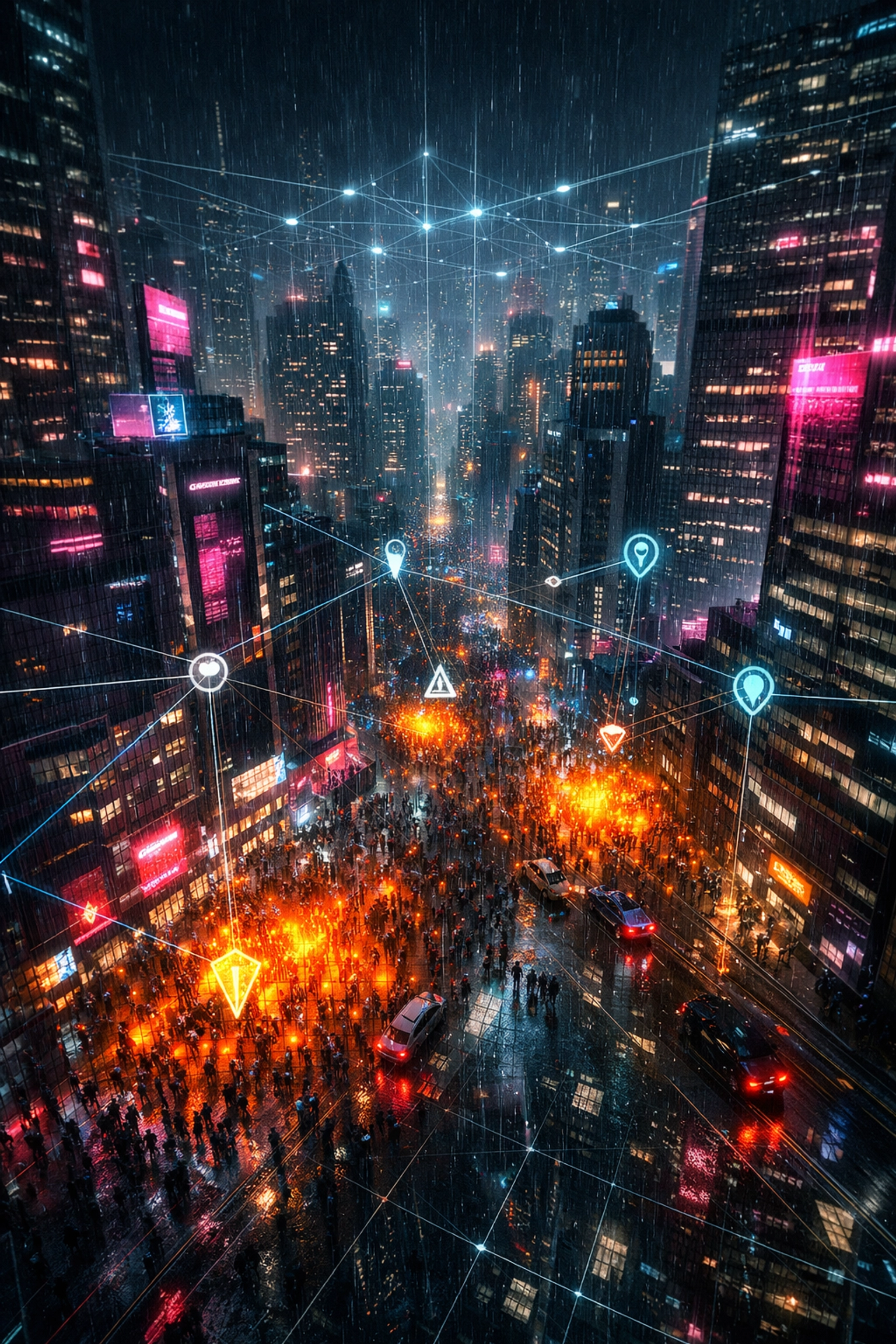
You might wonder why we like to read dystopian sci fi books when the real world feels a bit, well, dystopian already. It’s because these stories act as a “stress test” for our future.
By taking real-world AI developments: like the geopolitical threats of AI-driven weaponry or the ethical minefield of biotech implants: and putting them into a narrative, authors like Paul Corke allow us to process these fears safely. We get to see the worst-case scenarios play out on the page so we can hopefully avoid them in real life.
Techno thriller books are the “canary in the coal mine” for the digital age. They warn us about the loss of agency and the dangers of letting innovation outpace our ethics.
The “Secrets” Revealed
So, what’s the big secret? How are these books really shaped?
- Research is the new world-building: Authors are spending as much time reading white papers from AI labs as they are sketching out plot points.
- Focusing on the “Why”: It’s no longer enough to show a cool gadget. A great science fiction thriller book explains why that gadget changes what it means to be human.
- The Human Element: The more advanced the tech gets in the story, the more the author focuses on the human flaws: greed, love, fear: that drive the use of that tech.
Are You Ready for 2050?
The world of Symposium: The End of Tomorrow is closer than you think. Every time a new AI model is released or a new surveillance law is passed, we take a step closer to that 2050 version of Los Angeles.
If you’re a fan of high-stakes, intelligent, and grounded science fiction books, you need to see how Paul Corke has mapped out our potential future. It’s a ride that will make you look at your own devices a little differently.
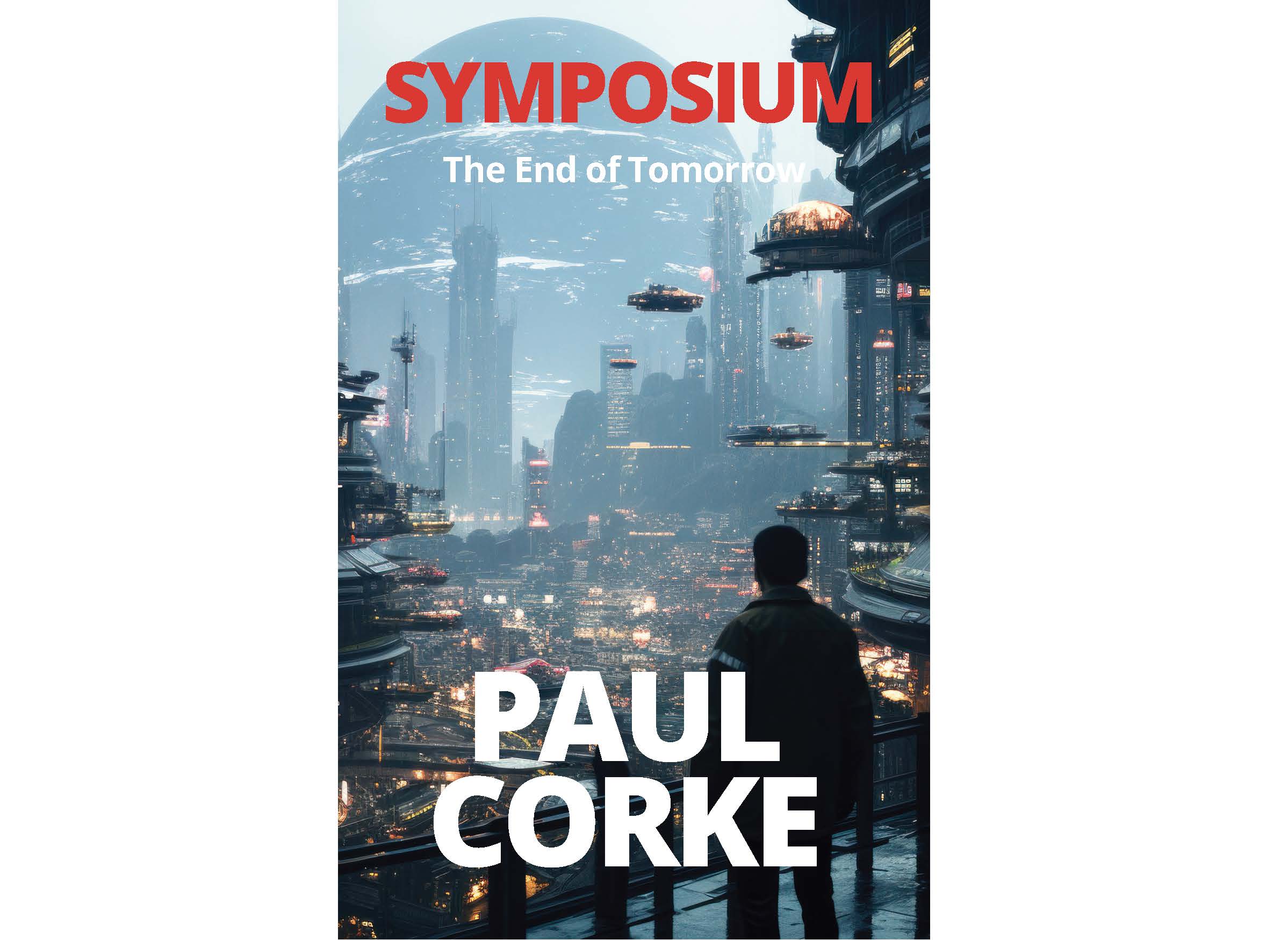
The future is being written right now: not just by authors, but by programmers and CEOs. If you want to stay ahead of the curve (and enjoy a pulse-pounding story while you’re at it), grab your copy of Symposium.
Check out the world of Alan and AL and ask yourself: How close are we really to the end of tomorrow?
[Explore Symposium: The End of Tomorrow here] – https://www.amazon.co.uk/Symposium-Tomorrow-Technothriller-Humanitys-Invention-ebook/dp/B0FW9LFM1B

Leave a comment