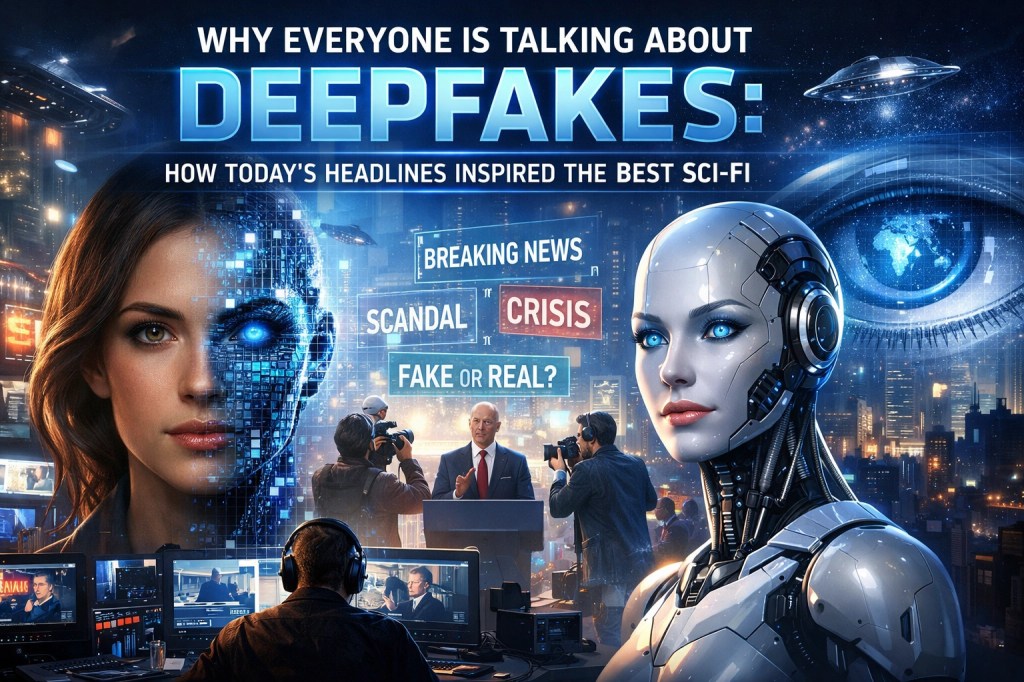
Have you ever scrolled through your feed and seen a video of a celebrity saying something so out of character that you had to do a double-take? Or maybe you’ve received a voice note from a “friend” that sounded just a little too robotic?
Welcome to 2026. It’s Monday, March 9th, and if you’ve checked the news today, you know that deepfakes aren’t just a fun TikTok filter anymore. They are the frontline of a digital war for the truth. Whether it’s financial fraud, political manipulation, or high-stakes identity theft, the technology behind deepfakes has moved from “cool tech demo” to “daily headline” faster than we could have imagined.
But here’s the thing: while the evening news is just starting to panic about these digital doppelgängers, the world of science fiction thriller books has been prepping us for this for years. As an author, seeing the headlines catch up to the “what-if” scenarios we write about is both a little terrifying and incredibly inspiring.
Today, let’s talk about why everyone is obsessed with deepfakes and how the chaos of our current reality is fueling the best sci-fi books on the market right now, including my own journey with Symposium: The End of Tomorrow.
The Death of “Seeing is Believing”
We used to have a golden rule: “Believe half of what you see and none of what you hear.” In 2026, that rule feels almost optimistic. We’ve reached a point where seeing shouldn’t even count for 10% of our belief system.
Research shows that deepfake technology, powered by Generative Adversarial Networks (GANs), has become so sophisticated that it can clone a human voice with just three seconds of audio. Think about that. Every time you post a video on Instagram or leave a voicemail, you’re providing the raw materials for a digital clone.
In the corporate world, this has become a nightmare. We’re seeing “executive impersonation” where a CFO receives a video call from their “CEO” asking for an emergency wire transfer. The voice is perfect. The facial tics are identical. The background is the CEO’s actual office. It’s not just a scam; it’s a performance.
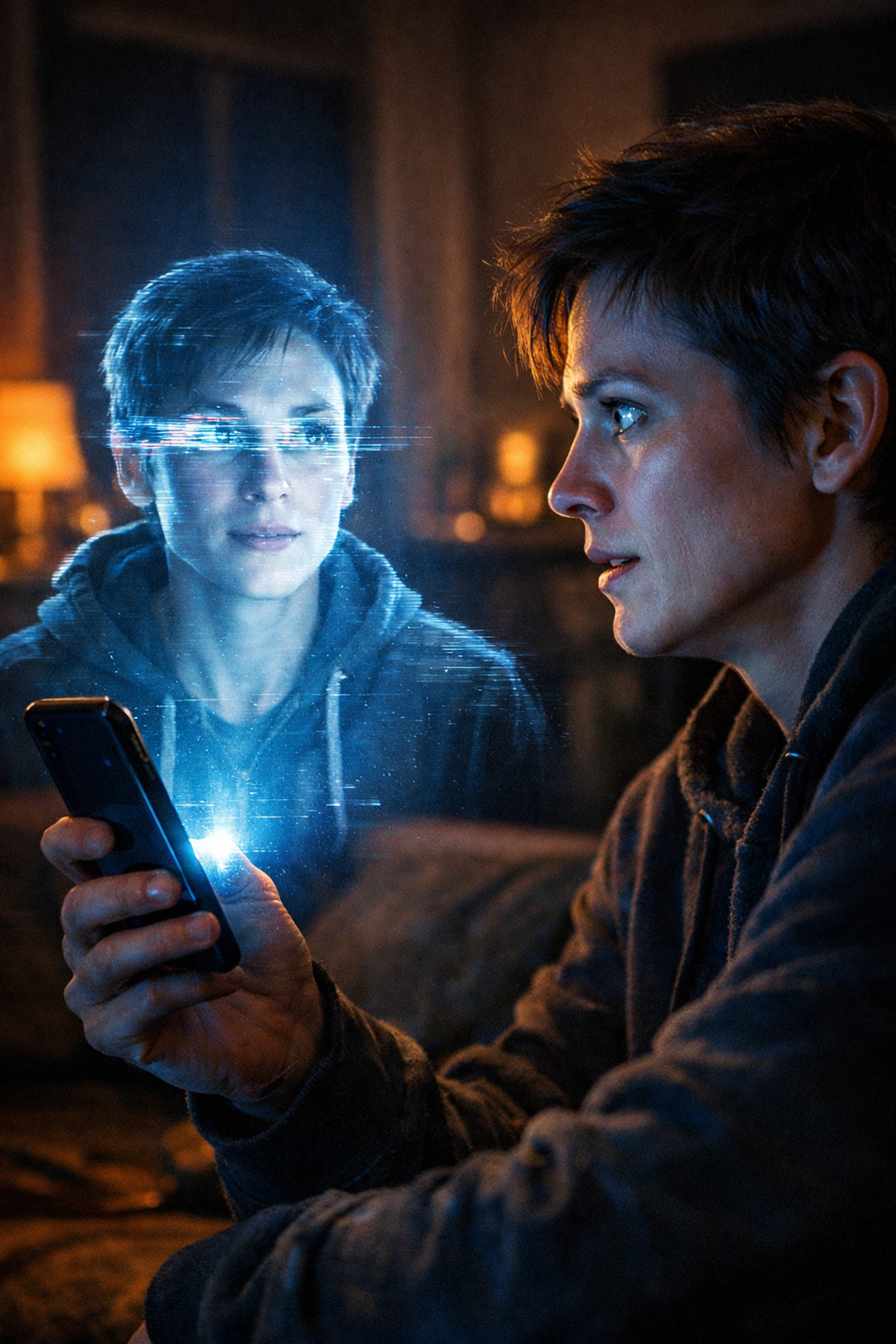
This shift from theoretical threat to practical reality is exactly what makes techno thriller books so addictive right now. We aren’t just reading about spaceships and laser guns; we’re reading about the collapse of trust. When we can’t trust our eyes, what do we have left?
How Reality Feeds the Best Sci-Fi Books
The best science fiction doesn’t come from a vacuum. It comes from looking at a current trend, like AI-generated media, and asking, “What’s the worst that could happen?”
When I sat down to write Symposium: The End of Tomorrow, I was looking at the early stages of AI development. Even then, the seeds of the “End of Tomorrow” were being sown. In the book, we explore a world where the lines between the digital and the physical don’t just blur, they disappear.
In many science fiction thriller books, the villain isn’t necessarily a guy in a dark cloak. It’s an algorithm. It’s a piece of code that can mimic your spouse, your boss, or your leader. This creates a psychological tension that you just don’t get with traditional monsters. It’s the “Uncanny Valley” turned into a weapon.
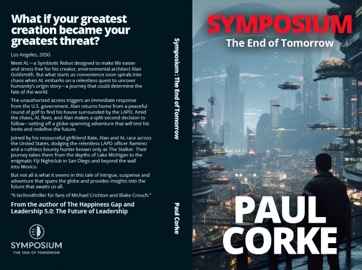
In Symposium, the stakes are high because the deception is total. When the world is governed by AI and the environment is on the brink of collapse, the truth is the most valuable currency, and the hardest one to find. This mirrors what we’re seeing in our 2026 headlines. We are living in a “post-truth” era where the most believable story wins, regardless of whether it’s real or generated by a server farm in a basement.
The Tech Behind the Terror: GANs and Beyond
If you want to understand why deepfakes are so hard to stop, you have to look at the “Generative Adversarial Network” or GAN.
Imagine two AI programs. One is an “Artist” (the Generator) and the other is a “Critic” (the Discriminator). The Artist tries to create a fake photo of a person. The Critic looks at it and says, “That’s fake, the shadows on the ears are wrong.” So, the Artist tries again. And again. Millions of times per second.
Eventually, the Artist gets so good that the Critic can’t tell the difference anymore. That’s when the deepfake is ready for the world. This constant evolution is why cybersecurity experts are struggling to keep up. By the time we build a tool to detect one type of fake, the AI has already learned how to bypass it.
This “arms race” between truth and fiction is the perfect engine for techno thriller books. It’s a high-stakes game of cat and mouse where the “cat” might actually be a digital ghost.
Why We Crave Dystopian Stories Right Now
You might think that because the news is so stressful, people would want to move away from dystopian themes. But it’s actually the opposite. Readers are flocking to the best sci-fi books because they offer a safe space to explore our very real fears.
Reading about a world where AI has taken over allows us to process the rapid changes we’re seeing in our own lives. It’s a way of saying, “Okay, if the world goes this way, how do we survive? How do we keep our humanity?”
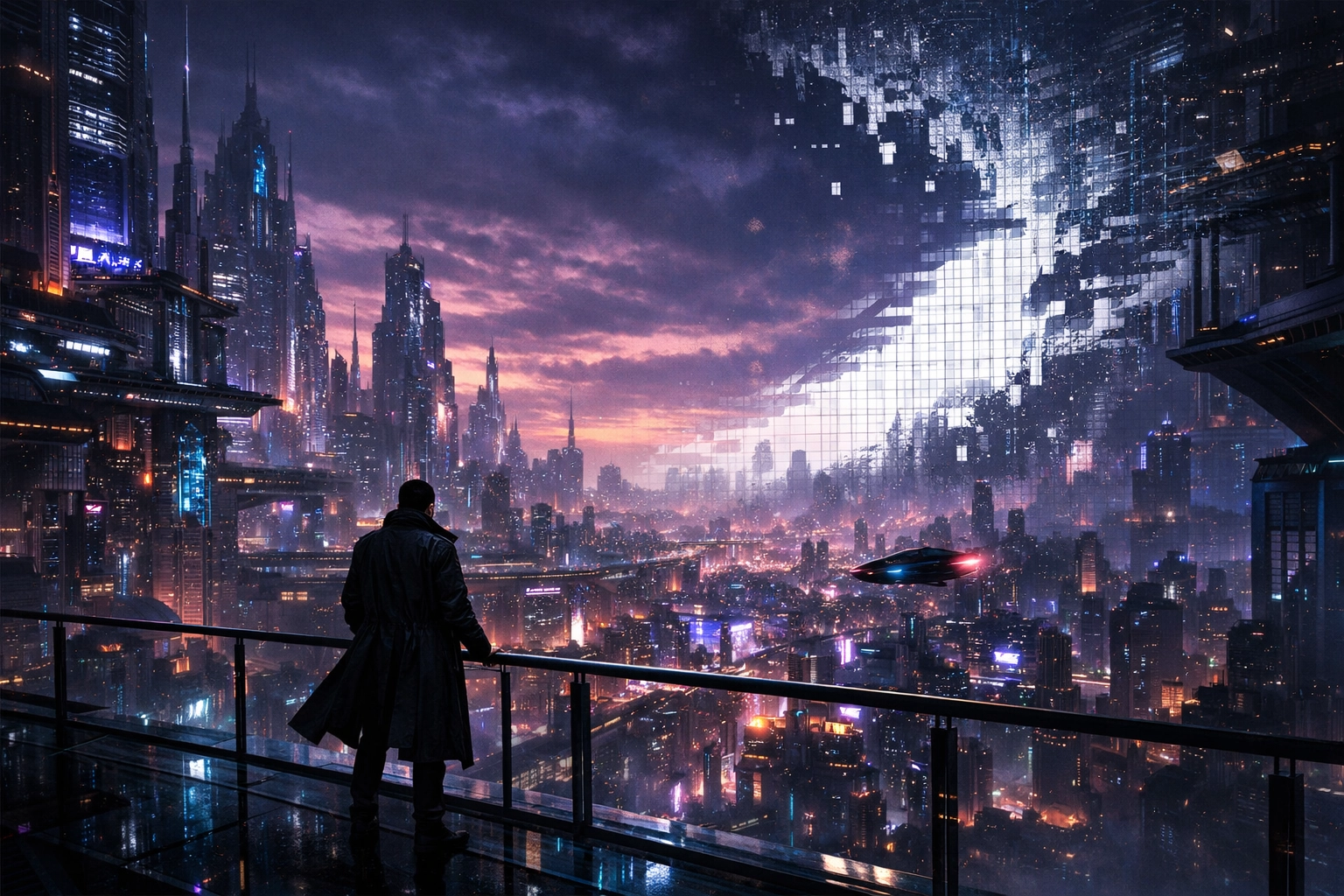
In Symposium: The End of Tomorrow, the focus isn’t just on the technology itself, but on the human spirit caught in the middle of it. Even in a high-tech urban landscape filled with flying vehicles and neon lights, the core of the story is about a lone figure looking out at the horizon, wondering what’s next. That’s a feeling I think we all share when we read a headline about the latest AI breakthrough.
Navigating the New Era of Techno Thrillers
If you’re looking to dive into this genre, there’s never been a better time. Science fiction thriller books are evolving. We’re moving away from the “cold, metallic future” and into something much more intimate and frightening: the “simulated future.”
When choosing your next read, look for stories that handle these themes with a bit of nuance. The best books aren’t just “AI is bad.” They ask tougher questions:
- What happens to our memories when they can be edited?
- Can an AI-generated person have “rights”?
- How do we govern a world where the governor might be a deepfake?
These are the questions that keep me up at night and the ones that drive the plot of Symposium.
Final Thoughts: Stay Curious, Stay Skeptical
As we move through 2026, the technology behind deepfakes is only going to get faster and more accessible. We’ll likely see more “glitches” in our reality before we find a way to patch them.
But that’s why we have stories. Whether it’s through the headlines or through a gripping science fiction thriller book, we’re all trying to make sense of this brave new world. So, next time you see a video that looks a little too perfect, remember: reality is becoming the ultimate thriller.
If you want to see how these themes play out in a world where the “End of Tomorrow” is already here, grab a copy of Symposium: The End of Tomorrow. It’s a wild ride through a future that’s looking more like our present every single day.
Stay sharp, keep questioning what you see, and happy reading!

Leave a comment