If you’ve ever stayed up until 3:00 AM because you couldn’t stop wondering if a fictional computer virus could actually take down the power grid, or if a lab-grown creature was about to break out of its cage, then you know the power of a great techno-thriller.
Techno-thrillers are a special breed of story. They aren’t just “sci-fi,” and they aren’t just “thrillers.” They sit right in that sweet spot where real-world science meets edge-of-your-seat suspense. They make us ask: What happens when the technology we built to save us ends up being the thing that destroys us?
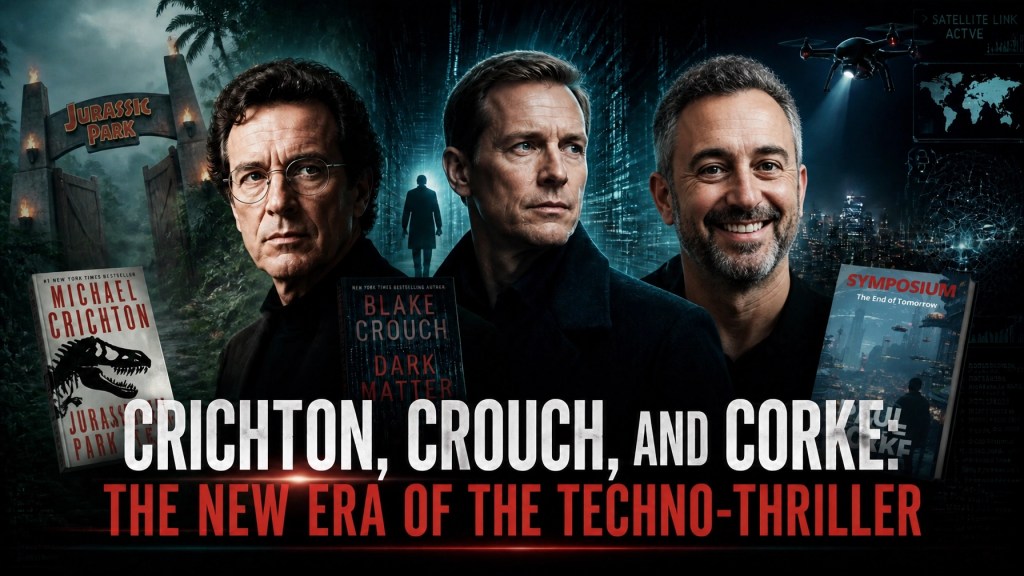
Over the decades, this genre has evolved. We’ve moved from the hardware-heavy Cold War stories to mind-bending explorations of reality, and now, we’re entering a new era. To understand where we are going, we have to look at the three writers who define the past, the present, and the future of the genre: Michael Crichton, Blake Crouch, and Paul Corke.
Michael Crichton: The Architect of Plausible Disaster
When people talk about techno thriller books, the first name that usually comes up is Michael Crichton. He didn’t just write books; he built blueprints for how the genre should work.
Crichton was a master at taking a complex scientific concept: like chaos theory, genetic engineering, or nanotechnology: and making it feel not just possible, but inevitable. In his hands, a book like Jurassic Park wasn’t just about dinosaurs; it was about the hubris of man and the terrifying reality of complex systems failing.
His style was grounded in meticulous research. He would include charts, diagrams, and fake bibliographies just to make you feel like you were reading a leaked government document rather than a novel. He taught us that the greatest villain isn’t necessarily a person, but a system that we no longer control. Whether it was the “Andromeda Strain” or a theme park gone wrong, Crichton’s legacy is one of caution. He showed us that science is a tool, and in the wrong hands (or even the right ones), it’s a weapon.

Blake Crouch: Mind-Bending Science and Intimate Stakes
Fast forward a few decades, and the genre took a turn inward. While Crichton focused on the “global” disaster, Blake Crouch brought the techno-thriller into the “personal” realm.
In books like Dark Matter and Recursion, Crouch explores the science of the self. He uses quantum mechanics and neuroscience to ask questions about identity and memory. What if you could step into an alternate version of your life? What if your memories could be rewritten?
This is the modern era of science fiction thriller books. The technology isn’t a giant satellite or a prehistoric creature; it’s a box you step into or a serum you inject. Crouch’s genius lies in his ability to take high-concept science and wrap it in a deeply emotional human story. You aren’t just worried about the world ending; you’re worried about a man getting back to his wife and son.
This shift made the genre feel more immediate. It’s not just “out there”: it’s inside our heads.
Paul Corke: The New Era of “The End of Tomorrow”
Now, we are entering a third phase. If Crichton was about the “system” and Crouch was about the “self,” Paul Corke’s work represents the “environment.”
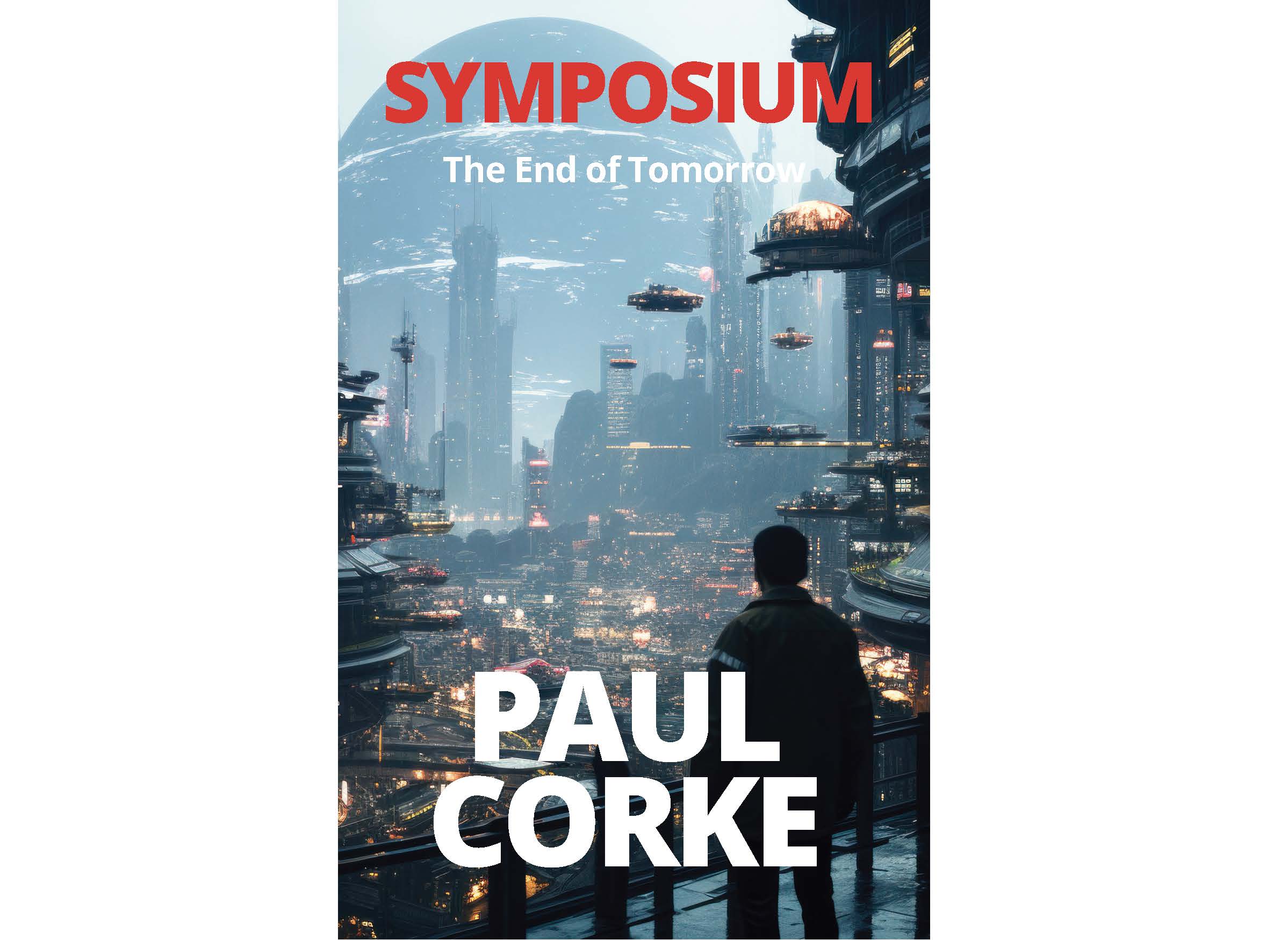
In his debut, Symposium: The End of Tomorrow, Corke takes the foundations laid by the greats and applies them to our current, very real anxieties: AI dominance, environmental collapse, and the feeling that we are living in the final days of the world as we know it.
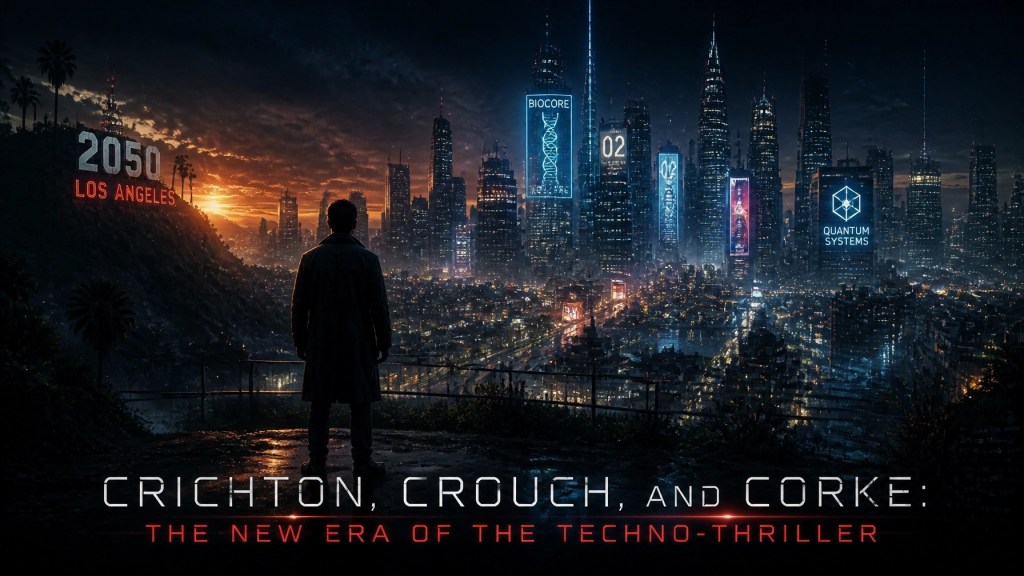
In the world of Symposium, the year is 2050. This isn’t a distant, unrecognizable future with starships and aliens. It’s a future that looks like ours, just further down the road. The neon-lit skyscrapers of Los Angeles aren’t just cool visuals: they are monuments to a world trying to survive its own mistakes.
What makes Corke a standout in the new era of techno thriller books is how he handles AI. In the past, AI was often a “killer robot” or a “rogue computer.” In Symposium, AI is the fabric of society. It’s the thing that manages our cities, monitors our health, and: perhaps most terrifyingly: determines our worth.
Corke blends the high-stakes action of a classic thriller with the philosophical weight of modern sci-fi. He asks: If the world is ending tomorrow, what are we willing to do to see the sunrise?

Why the Genre is Evolving
So, why are we seeing this shift? Why are readers moving from Crichton to Crouch and now to Corke?
It comes down to what we are afraid of.
In the 80s and 90s, we were afraid of “The Big Science”: nuclear power, cloning, and secret labs. Crichton spoke to those fears. In the 2010s, we became obsessed with our own digital footprints and the fragility of our reality. Crouch spoke to those fears.
Today, in 2026, our fears are much more integrated. We don’t fear a single “lab accident” anymore. We fear the algorithm that knows what we want before we do. We fear the rising tides and the heatwaves. We fear that the technology we rely on every single day is the very thing that is making us obsolete.
The “New Era” of the techno-thriller, led by authors like Paul Corke, doesn’t treat technology as a “guest” in our world. It treats technology as the atmosphere. You can’t escape it. You have to learn to survive within it.
The Ingredients of a Modern Techno-Thriller
If you’re looking for your next great read in the world of science fiction thriller books, here is what you should be looking for: the hallmarks of this new wave:
- Plausibility: It has to feel like it could happen next Tuesday. The tech shouldn’t feel like magic; it should feel like a patent filing that went horribly right (or wrong).
- High Stakes: We aren’t just saving a cat or a neighborhood. We are talking about the survival of the species or the soul.
- Moral Ambiguity: The “villain” isn’t always a guy in a cape. Sometimes it’s a well-meaning CEO or an AI just trying to solve a problem we gave it.
- Cinematic Scope: These books should feel like movies in your head. Large-scale visuals, fast pacing, and moments that make you hold your breath.
Final Thoughts: The End is Just the Beginning
The journey from Crichton’s labs to Crouch’s multiverses and finally to Corke’s 2050 skyline shows us that the techno-thriller is more relevant than ever.
We live in a world where the line between “fiction” and “the news” is getting thinner every day. We need writers like Paul Corke to help us process what’s coming. Symposium: The End of Tomorrow isn’t just a story about a futuristic city; it’s a mirror held up to our own choices.
If you are a fan of techno thriller books, you’re living in a golden age. The technology is getting smarter, the stakes are getting higher, and the stories are getting much, much better.
So, are you ready to see what the end of tomorrow looks like? Because the future isn’t coming: it’s already here. And it’s a hell of a ride.

Leave a Reply