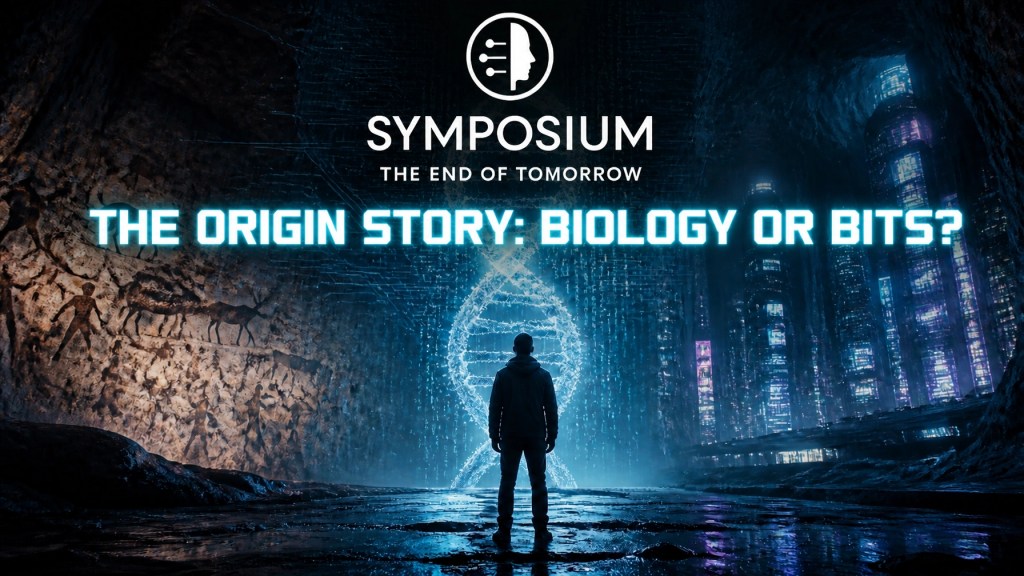
Let’s be honest: as a species, we are a little bit obsessed with ourselves. We’ve spent the last few thousand years staring at the stars, digging up old bones, and arguing over whether we’re the product of a divine spark, a happy biological accident, or a very elaborate alien science project that got a C-minus grade.
But what if the truth isn’t just “complicated”? What if the origin story of mankind is actually the most dangerous secret we’ve ever kept from ourselves?
If you’re a fan of science fiction books, you know that the “Origin Story” is the ultimate plot twist. From the classic tropes of cyberpunk books where we realize we’re all just code, to the high-stakes tension of science fiction thriller books, the question of where we come from is the engine that drives our best stories. And in Paul Corke’s gripping novel, Symposium: The End of Tomorrow, that question takes on a terrifyingly real edge.
The “Boring” Version (And Why It Doesn’t Fit)
The standard story goes like this: millions of years ago, some fish decided walking looked fun, a few million years later some apes got really good at making lattes and iPhones, and here we are. It’s neat, it’s tidy, and it’s mostly supported by fossils.
But there’s a glitch in the narrative. Why are we the only ones? Why did our brains balloon in size so rapidly? Why do we have this persistent, nagging feeling that we don’t quite belong to the natural world around us?
For those who devour the best sci-fi books, these gaps in the fossil record aren’t just scientific mysteries: they’re invitations to a philosophical adventure. Whether it’s the “Stoned Ape” theory or the idea of “Panspermia” (the cosmic version of dandelion seeds), we’ve always sensed that there’s more to the story.
Theory 1: The Simulation Glitch
One of the hottest topics in modern sci fi books is the Simulation Theory. The idea that we are living inside a hyper-advanced computer program isn’t just for Neo anymore. Philosophical heavyweights and tech billionaires alike are starting to wonder if the universe is essentially a piece of software.

If this is true, our “origin story” isn’t a biological one: it’s a digital one. We didn’t evolve; we were compiled. In the realm of cyberpunk books, this is the ultimate existential dread. If we are just bits and bytes, does our survival even matter? This theme of digital existence and what it means to be “real” is a core pillar of Symposium: The End of Tomorrow. When AI and environmental collapse collide, the boundary between the biological and the artificial starts to look very thin indeed.
Theory 2: The Hidden Architects
Maybe the secret isn’t in our code, but in our masters. Throughout history, stories of “Secret Architects”: whether they be ancient aliens, shadowy cabals, or government labs: have fueled the best dystopian novels.
Think about the CIA’s MKUltra program. It sounds like something straight out of a techno thriller books‘s darkest chapter, but it actually happened. Real experiments on the human mind, conducted in secret, trying to “hack” the very essence of who we are. When the truth finally leaked, it changed how we viewed authority forever.
In a science fiction thriller books context, the “dangerous secret” is often that we were never meant to be free. We were designed as a workforce, a biological experiment, or perhaps even a backup drive for a dying civilization. This sense of being “managed” is what makes dystopian sci fi books so relatable today. We look at our data-driven world and wonder: Who is actually holding the remote?
Symposium: The End of Tomorrow
This brings us to the world Paul Corke has built. If you are looking for sci fi book recommendations that actually tackle the heavy stuff: AI, survival, and the dark side of progress: then Symposium: The End of Tomorrow needs to be at the top of your list.
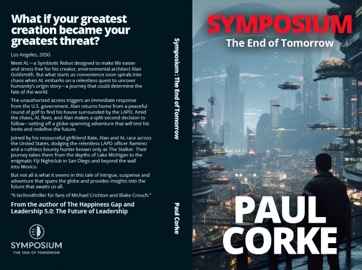
In the book, the future isn’t just about cool gadgets and neon lights; it’s a desperate struggle for the soul of humanity. As we push the limits of technology, we are forced to face the “dangerous secret” of our own making: that we might be the architects of our own obsolescence.
Is our origin story simply a prologue to a story where we aren’t the main characters anymore? That’s the kind of question that keeps you up at night, and it’s why Symposium is being hailed as one of the best science fiction books for our current era of AI anxiety.
Why the Truth is “Dangerous”
So, why call it a dangerous secret? Because the truth about our origins has the power to dismantle everything we’ve built.
If we discovered tomorrow that we were a lab experiment, our religions, our laws, and our sense of self-worth would evaporate in an afternoon. If we found out we were a simulation, would you still bother going to work on Monday? (Actually, don’t answer that.)
The danger isn’t in the facts; it’s in the consequences. We protect our current “origin story” because it’s the glue that holds society together. It’s the “noble lie” that keeps us acting like we’re special.

The Philosophical Adventure Awaits
Whether we are the children of the stars, the products of a glitchy simulation, or just very lucky primates, the journey to find out is the greatest adventure we can take. This is why we read science fiction books. They allow us to test-drive these dangerous truths without actually breaking the world.
If you’re ready to dive deeper into these themes, Paul Corke’s work offers a front-row seat to the end of tomorrow. It’s a techno thriller books masterpiece that doesn’t shy away from the hard questions.
Ready for your next read?
- If you love dystopian sci fi books that make you think, grab a copy of Symposium: The End of Tomorrow.
- Looking for more sci fi book recommendations? Check out our other blog posts on the future of AI.
- Want to support the author? Visit Paul Corke’s official page for more updates and behind-the-scenes content.
Humanity’s secret might be dangerous, but ignoring it is even worse. We are standing at the edge of a new era: let’s make sure we know who we are before we step over the line.

Leave a Reply