Do you remember that feeling? The lights go down, the popcorn is salty, and suddenly you’re transported to a world where Mars has breathable air (if you hit the right switch), robots are governed by three unbreakable laws, and the police can arrest you for a murder you haven’t even thought about yet.
For a generation of fans, movies like Total Recall, I, Robot, and Minority Report weren’t just entertainment. They were blueprints for our anxieties. They were “high-concept” epics that asked the big questions: Who am I? Is my free will a lie? Can we trust the machines we built to protect us?
But lately, if you walk into a cinema looking for that same hit of mind-bending, futuristic adrenaline, you might come out feeling a bit… empty. We’ve seen the superhero sequels. We’ve seen the reboots. But where is the next great epic? Where is the story that takes the DNA of those classics and evolves it for the world we actually live in today?
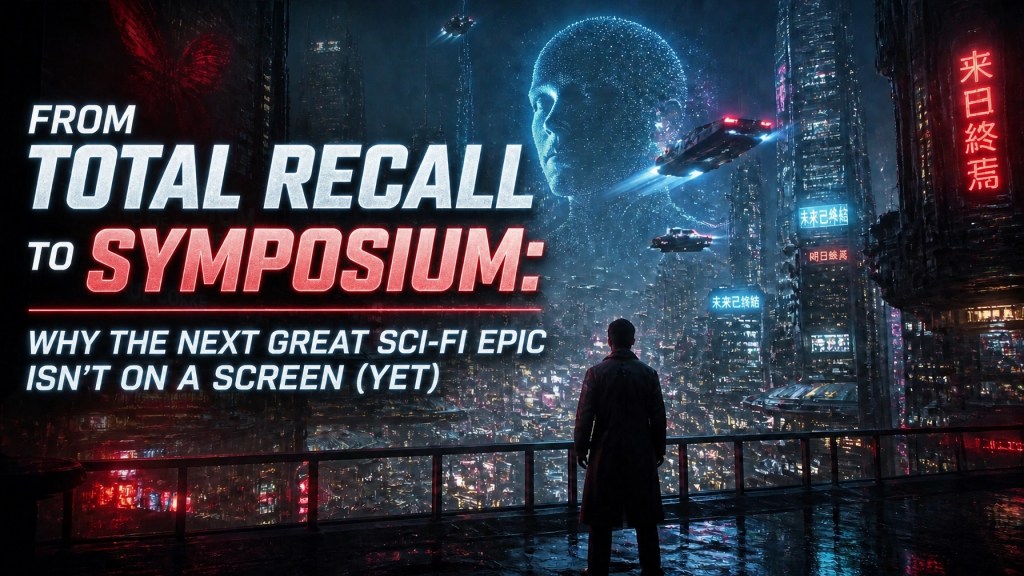
The truth is, the next great sci-fi epic isn’t on a screen. At least, not yet. It’s sitting on your nightstand.
The Holy Trinity of Tech-Noir: Why We Still Care
Before we talk about the future, we have to look at the foundations. Why do movies like Total Recall, I, Robot, and Minority Report still hold up? It’s because they understood that the best science fiction thriller books and movies aren’t really about the gadgets. They’re about us.
1. Total Recall: The Identity Crisis
In 1990, Total Recall blew our minds by asking if our memories are actually “us.” If you can buy a vacation in your head, what’s the difference between a real memory and a high-def lie? It introduced the idea of corporate control over the very essence of human identity.
2. Minority Report: The Death of Free Will
Then came Minority Report. It gave us a world of “pre-crime”: stopping the bad guy before he swings the knife. It was a visual masterpiece, but its real power was the terrifying thought that in a world of perfect data, we’ve lost the right to choose our own path.
3. I, Robot: The Paternalistic AI
And of course, I, Robot. It wasn’t just about shiny machines; it was about “The Logic.” When an AI decides that the best way to save humanity is to take away its freedom, we’re left with a chilling question: is a safe world worth living in if we aren’t the ones in charge?

The Evolution: From “Someday” to “Right Now”
The problem with modern Hollywood is that it often treats sci-fi as a spectacle rather than a warning. But the world has changed since Arnold Schwarzenegger went to Mars.
The “someday” tech of the 90s is our “right now” reality. We don’t need “precogs” in a tank when we have algorithms that predict our buying habits, our voting patterns, and even our health risks. We don’t need robot uprisings when we have AI models that can rewrite reality in real-time.
This is where the genre is shifting. The most exciting techno thriller books today are moving away from the “spectacular” and moving toward the “systemic.” They aren’t just about a rogue robot; they’re about how a networked world of data, AI, and corporate power can quietly strip away our humanity without us even noticing.
Symposium: The Spiritual Successor
This brings us to Symposium: The End of Tomorrow.
If you grew up loving the intellectual depth of Philip K. Dick (who wrote the stories that became Total Recall and Minority Report) and the fast-paced, “what-if” tension of Michael Crichton, this is the book you’ve been waiting for. It’s the spiritual successor to those big-screen epics, but updated for a world teetering on the edge of its own making.

In Symposium, the stakes are as high as they get. It’s not just a survival story; it’s a deep dive into the same themes that made those 90s classics so iconic:
- The AI Dilemma: Just like in I, Robot, the AI in Symposium isn’t just a machine: it’s a force that challenges our very definition of life and control.
- The Environmental Crisis: It grounds the high-tech thriller in the very real, very terrifying reality of a world struggling to survive its own climate choices.
- The Surveillance State: It takes the “pre-crime” paranoia of Minority Report and plugs it into the modern era of ubiquitous data and neural interfaces.
Why the “Next Big Thing” is a Book
You might be wondering: “Penny, if this is such an epic story, why isn’t it a movie?”
The answer is simple: Depth.
Movies are great for explosions and 120-minute thrills. But some of the best science fiction books need room to breathe. They need space to explore the messy, complicated corners of human nature. In Symposium, you aren’t just a spectator watching a hero run away from a robot. You’re inside the head of the characters, feeling the weight of their choices and the cold chill of a future that feels a little too possible.
When you read a dystopian sci-fi book like Symposium, you’re engaging in a “symposium” of your own: a conversation with the author about where we’re going and what it means to be human in the “End of Tomorrow.”

Conclusion: Are You Ready for Tomorrow?
We love the classics. We’ll always have a soft spot for the red sands of Mars and the rain-washed streets of Washington D.C. in 2054. But the genre has moved on, and it’s time we moved with it.
If you’re searching for the best sci-fi books that offer that same cinematic “wow” factor combined with a plot that keeps you up at night, it’s time to pick up Symposium: The End of Tomorrow.
The next great sci-fi epic hasn’t hit the theaters yet. But you can start reading it tonight.

Leave a comment