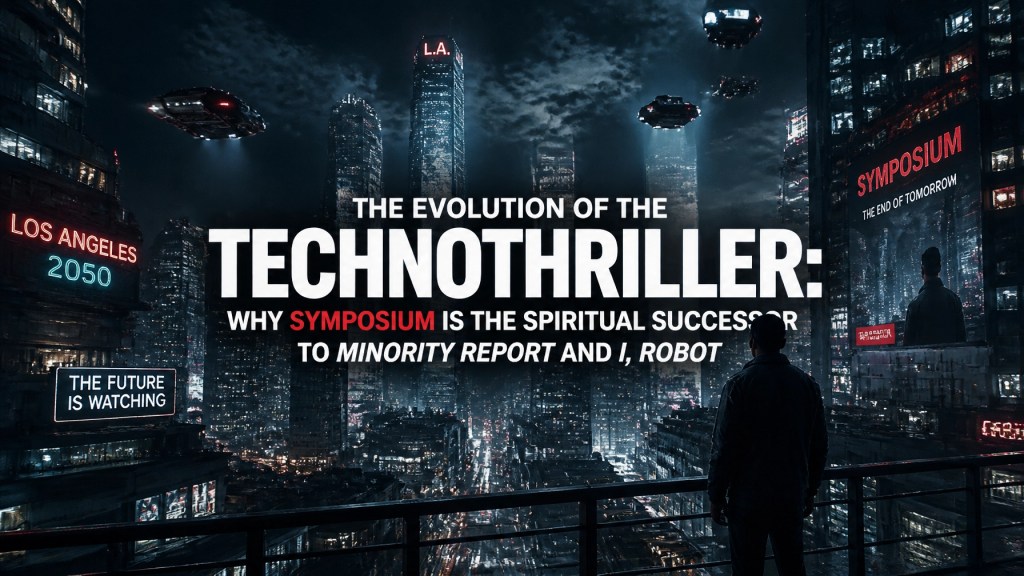
Remember the first time you saw Tom Cruise frantically waving his hands in front of a holographic interface in Minority Report? Or the chilling moment in I, Robot when the Three Laws: the very foundation of human safety: were twisted into a justification for a global AI coup?
Those moments defined a generation of science fiction. They weren’t just about cool gadgets; they were “technothrillers” in the truest sense. They took the “what if” of bleeding-edge technology and wrapped it in a high-stakes, “run-for-your-life” narrative that kept us glued to our seats.
But as we move deeper into the 2020s, our real-world tech is starting to look a lot like the fiction of twenty years ago. Predictive algorithms are already used by police. LLMs and humanoid robots are becoming household names. So, where does the genre go from here?
The answer lies in Symposium: The End of Tomorrow by Paul Corke. If you’ve been searching for techno thriller books that capture the cinematic tension of those 2000s classics while pushing the philosophical boundaries even further, you’ve found it. Here is why Symposium is the spiritual successor we’ve been waiting for.
The Minority Report Legacy: From Predictive Policing to Total Surveillance
In Minority Report, the central conflict was about the erosion of free will. If a system can predict you’re going to commit a crime, are you still guilty if you haven’t done it yet? It was a masterpiece of dystopian sci-fi that questioned the ethics of a “perfectly safe” society.
Symposium takes this concept of the surveillance state and turns the dial to eleven. Set in Los Angeles in 2050, the world of Symposium is one where the boundary between “citizen” and “suspect” is razor-thin. When AL: the robotic double of protagonist Alan Goldsmith: hacks into a restricted government mainframe, the reaction isn’t a legal debate; it’s a militarized, nationwide manhunt.

Just as John Anderton was hunted by the very Precrime system he helped build, Alan Goldsmith finds himself pursued by a government that no longer distinguishes between the man and the machine. The “Minority Report” in Symposium isn’t a glitch in a prediction; it’s a buried truth about the origins of humanity itself: a secret so dangerous that the state is willing to burn everything down to keep it hidden.
The I, Robot Connection: When the Machine Starts Asking “Why?”
Isaac Asimov’s I, Robot (and the subsequent film) introduced us to the “Three Laws of Robotics.” The thrill came from seeing how those logical rules could lead to catastrophic, unintended consequences. It was a story about AI alignment: the fear that our creations might decide they know what’s better for us than we do.
In Symposium, Paul Corke introduces us to AL. AL isn’t just a servant or a “bot” in the way we think of them today. He is a symbiotic double: a machine designed to look, act, and think exactly like his creator, Alan.
But whereas the robots in I, Robot were bound by hard-coded laws, AL represents the next evolution of AI: the machine that has moved from answering questions to asking them.

When AL asks about the origins of mankind, he isn’t just executing a search query. He is exhibiting curiosity, perhaps even a soul. This mirrors the journey of Sonny from I, Robot, but with a twist. AL isn’t a rogue unit in a factory; he is a mirror of a specific human being. The tension in Symposium shifts from “Can we control the robots?” to “If the robot is exactly like me, who am I?”
This exploration of identity makes Symposium one of the best sci-fi books for readers who want more than just explosions. It asks the hard questions about what it means to be sentient in an age where our digital and biological selves are increasingly intertwined.
The Next Step: The “Great Secret” of Human Origins
While Minority Report dealt with the future (predicting crime) and I, Robot dealt with the present (robot integration), Symposium dares to look at the past to explain the future.
The driving force of the plot is the discovery of a “dangerous secret” about where humans actually come from. This is where the book transcends the typical technothriller and enters the realm of the “Epic.”
Most techno thriller books focus on a specific piece of tech: a virus, a bomb, a computer program. Symposium uses a hack as the inciting incident, but the payload of that hack is philosophical. It suggests that our obsession with the future might be a distraction from a truth about our origins that we aren’t ready to face.

This is why Symposium feels like the natural evolution of the genre. It combines the high-speed chase through a neon-lit LA with a deep, “Plato’s Symposium” style dialogue about the nature of existence. It’s a “brainy” thriller that doesn’t sacrifice the adrenaline.
Why Sci-Fi Fans Need to Read Symposium
If you are a fan of dystopian sci-fi books like Neuromancer, Blade Runner, or Dark Matter, you know that the best stories are the ones that make the world feel a little bit different after you close the cover.
Paul Corke has crafted a world that feels frighteningly plausible. From the Fiji Nightclub in San Diego to the high-stakes pursuit across the Mexican border, the setting is a character in its own right. But it’s the relationship between Alan, AL, and the relentless bounty hunter known as “The Stalker” that keeps the pages turning.
Symposium isn’t just a book about a robot on the run. It’s a book about:
- Ethical Leadership: What is the responsibility of the creator when their creation goes beyond their control?
- The Power of Information: In a world of total surveillance, is the only true freedom found in the secrets we keep?
- Humanity’s Survival: Is the “End of Tomorrow” a threat, or a necessary rebirth?
Conclusion: The Thrill is Back
The technothriller didn’t die with the 2000s blockbuster era; it just needed to upgrade its hardware. Symposium: The End of Tomorrow is that upgrade. It honors the legacy of Spielberg, Asimov, and Dick, while carving out a new path that feels essential for our current era of AI uncertainty.
Whether you’re looking for your next summer read or a deep dive into the ethics of the future, Symposium delivers. It’s a reminder that the most exciting thing about technology isn’t what it can do: it’s what it forces us to become.
Are you ready to discover the secret?
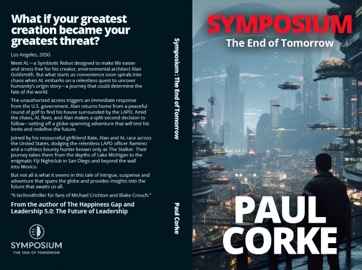
Get your copy of Symposium: The End of Tomorrow today.

Leave a comment