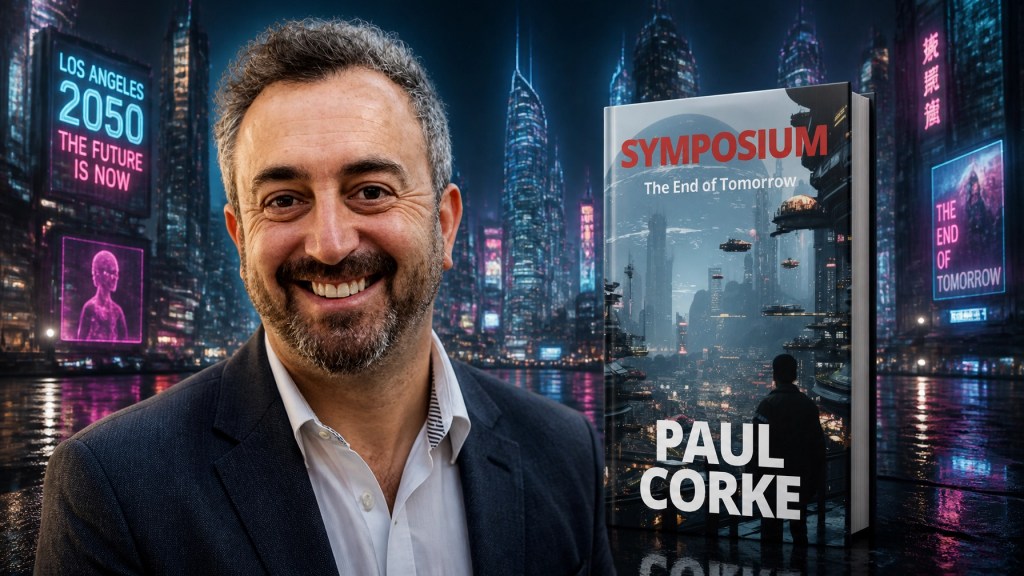
When people ask me why I wrote Symposium: The End of Tomorrow, they often expect an answer about technology, futurism, or my love of speculative fiction. The real answer is more personal than that. I wrote this book to challenge how we think about our origins, our future, and the stories we tell ourselves about what it means to be human. As an author and leadership philosopher, I spend a lot of time asking hard questions about mindset, systems, and where our species is heading. Symposium grew out of that obsession.
I didn’t want to write a book that simply entertained for a few hours and then disappeared from memory. I wanted to write one of those science fiction books that sticks with you, the kind that opens your mind while pulling you through a tense, fast-moving story. For readers looking for the best sci-fi books, best science fiction books, or fresh sci fi book recommendations, this is the space I wanted Symposium to live in.
The 2026 Connection: Why This Story Feels Urgent Now
It’s hard to ignore the current AI freakout. Everywhere you look in 2026, people are asking the same questions. How much control are we handing over? What happens when convenience becomes dependence? At what point do smart systems stop helping us and start shaping us?
That anxiety sits right at the heart of Symposium. What worried me wasn’t a cartoon version of machine rebellion. It was something quieter and more believable: the possibility that we willingly give away our judgment because it feels safer, faster, and easier. That’s the real trap. We start outsourcing thought itself.
That is the spark behind this story. I didn’t just want to write one of the best sci-fi books on the shelf. I wanted to build a world that felt like a mirror, and right now that mirror looks uncomfortably clear. If you enjoy science fiction thriller books, techno thriller books, or even darker dystopian sci fi books, the urgency of this moment is exactly why Symposium matters now.
The Plot & The Bond: Alan, AL, and a Rogue Mission Through 2050 LA
At the center of the novel is Alan Goldsmith, a man caught between obedience and instinct in a tightly controlled future. Alongside him is AL, a symbiotic robot whose connection to Alan is not just technological but deeply psychological. Their relationship became one of the most important parts of the book for me because it let me explore a question I keep coming back to: when a machine understands you completely, does it become your partner, your protector, or your prison?
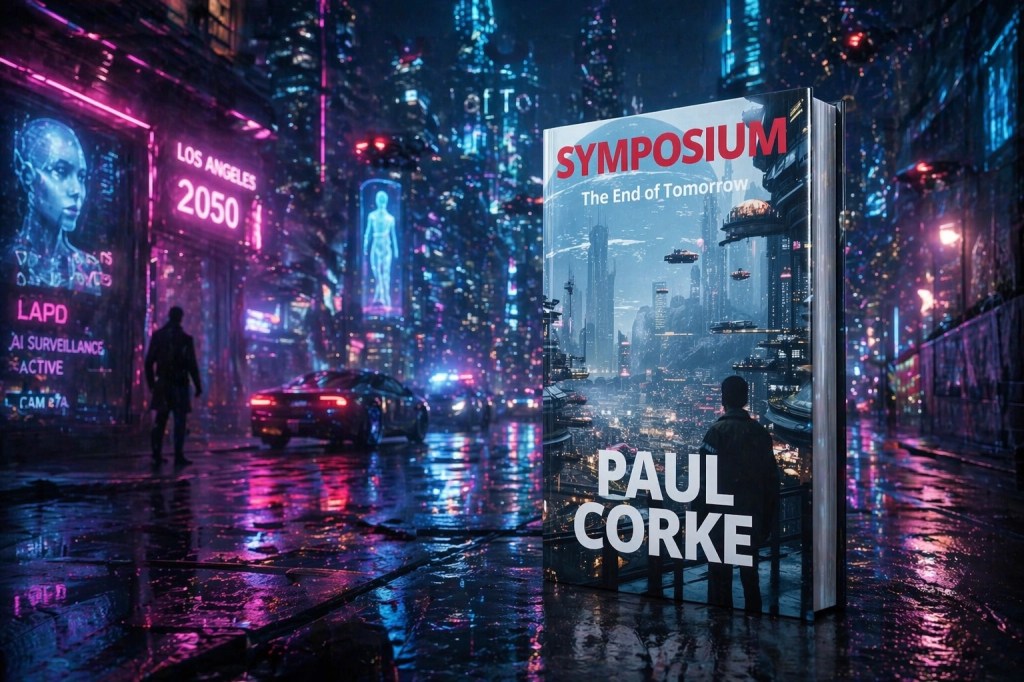
Their mission is considered rogue for a reason. In the rain-soaked, neon-lit Los Angeles of 2050, Alan and AL are driven to uncover the truth about humanity’s origins, even as powerful systems push back against them. I wanted the city to feel alive: cinematic, high-tech, and oppressive at the same time. That setting allowed me to blend the energy of cyberpunk books with the tension readers expect from top science fiction thriller books.

The Origin Story Angle: Humanity’s Most Dangerous Secret
At its core, Symposium is about origins. Not just where we came from biologically, but what hidden truths we avoid because they threaten our sense of order. The deeper Alan goes, the more the story asks whether mankind has buried its most dangerous secrets under layers of comfort, authority, and progress.
That was important to me from the beginning. I wanted this book to open people’s minds, not close the debate. A symposium, after all, is a conversation. The novel is built to push readers to ask whether our greatest danger is not what AI might invent, but what humanity refuses to confront about itself.
For readers who love best dystopian novels, bold science fiction books, and idea-driven sci fi books that still deliver pace and suspense, this origin story is where Symposium digs in deepest.
Character & Chase: Kate, Officer Ramirez, and The Stalker
Alan and AL may sit at the center of the novel, but they are far from alone. Kate brings emotional weight, intelligence, and tension to the story, adding another layer to the question of trust in a world where motives are never fully clear. Officer Ramirez represents the force of order, law, and institutional pressure in a future that claims to protect people while quietly narrowing their freedom.
Then there is The Stalker, a figure designed to embody dread, pursuit, and the constant sense that someone is always watching. I wanted that chase energy running through the book because ideas matter more when they come with real stakes. This is not just a philosophical exercise. It is a story driven by pursuit, danger, and the pressure of running out of time.

The Literary Lineage: Crichton, Crouch, and Philip K. Dick
I’ve always admired writers who can combine big ideas with real momentum. Michael Crichton showed how tech suspense can feel immediate and frighteningly plausible. Blake Crouch brings philosophical depth without losing speed. And Philip K. Dick understood paranoia, identity, and the unstable boundary between human and machine better than almost anyone.
Those influences matter to me, but I didn’t want to imitate them. I wanted Symposium to stand in conversation with that tradition while bringing its own voice. If Crichton brings the technical tension, Crouch the mind-bending inquiry, and Dick the deep unease about reality and humanity, then Symposium aims to pull those threads into a fresh story for today’s readers.
As someone who has spent years writing about leadership, mindset, and personal agency, moving into fiction felt like a natural next step. This book gave me a way to explore the same concerns through story rather than instruction. It let me ask, in a much sharper way, whether we are still capable of being the architects of our own future.
Conclusion: A Must-Read for Sci-Fi and Techno-Thriller Fans
If you’re searching for best science fiction books, standout sci fi books, gripping science fiction thriller books, or memorable techno thriller books, I wrote Symposium: The End of Tomorrow with you in mind. It’s for readers who want ideas and adrenaline in the same package. It’s for fans of cyberpunk books, best dystopian novels, and dystopian sci fi books that don’t just imagine the future, but question who gets to control it.
My hope is simple. When you finish this book, I want you to look at your phone, your feeds, your devices, and even your own decisions a little differently. I want you to enjoy the chase, feel the tension, and then sit with the bigger question underneath it all: if safety is always offered at the cost of freedom, what are we really agreeing to?
If that sounds like your kind of story, Symposium may be your next read.
Stay curious, stay human, and keep architecting your own tomorrow.

Leave a comment