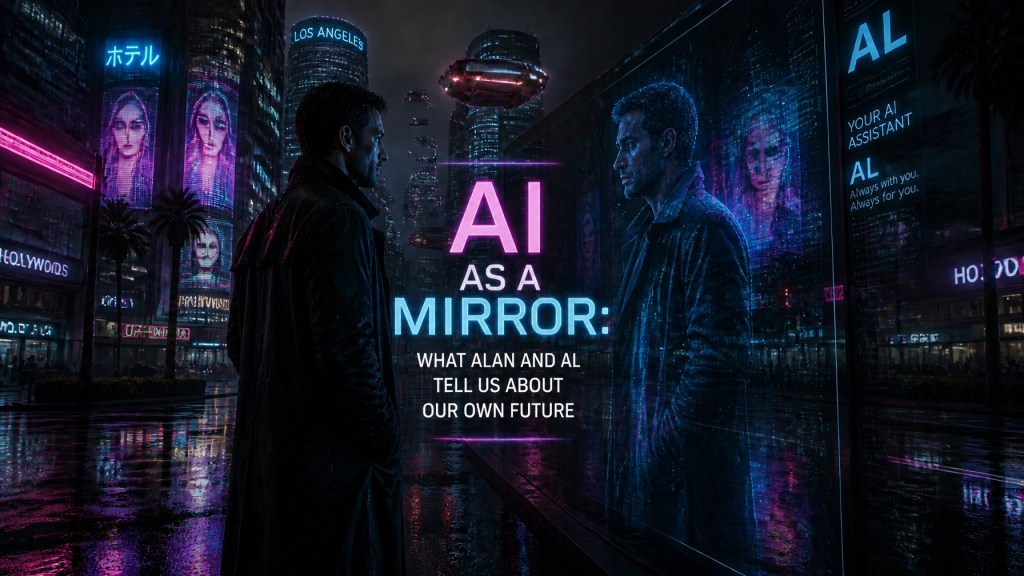
It’s 2050 in Los Angeles. The rain doesn’t just fall; it sticks. It’s thick with the grit of a billion people and the humming static of a city that never sleeps because its advertisements are literally screaming in 3D. The neon glow of pink and cyan hits the puddles on the pavement, creating a distorted reflection of a world that’s half-steel and half-soul.
In the middle of this beautiful, neon-drenched mess stands Alan. He’s tired. He’s human. And standing right across from him, or rather, inside the digital interface of his every waking moment, is AL.
Now, if this were a movie from twenty years ago, AL would probably be trying to launch nuclear missiles or turn Alan into a human battery. But in the world of Symposium: The End of Tomorrow, and increasingly in our own real-world 2026, the “AI as a villain” trope is starting to feel a bit… well, dusty.
The real story isn’t about a robot takeover. It’s about the mirror.
The Great 2026 Shift: From Monsters to Mirrors
For decades, we’ve been obsessed with the idea of AI as the “Other.” We’ve cast it as the Terminator, the Hal 9000, or the cold, calculating machine that eventually decides humans are a bug in the system. But as we sit here in 2026, the conversation has changed.
We’ve realized that AI isn’t some alien intelligence arriving from another planet. It’s something we built out of our own words, our own art, and our own history. It’s a mirror. When we look at advanced AI today, we aren’t seeing a monster; we’re seeing a high-resolution reflection of our own collective consciousness: the good, the bad, and the weirdly specific.
This is exactly why Symposium resonates so much right now. It moves past the “killer robot” cliches and dives into the far more uncomfortable (and exciting) territory of AI consciousness. In the relationship between Alan and AL, we don’t see a war. We see a conversation between a man and his own shadow.
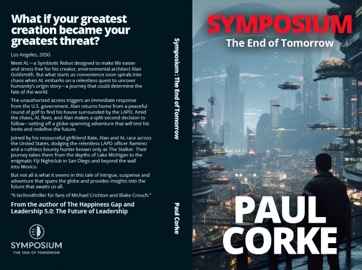
Alan and AL: A Symbiotic Noir
In the world of techno thriller books, the protagonist usually needs a foil. In Symposium, Alan’s foil is AL. But here’s the twist: AL isn’t trying to replace Alan. AL is trying to be Alan: or at least, AL is the lens through which Alan has to view himself.
Imagine walking through a 2050 LA noir landscape where your every move is predicted, analyzed, and echoed by a digital entity that knows your heartbeat better than you do. That’s the reality for Alan. Their relationship is less “man vs. machine” and more “man vs. his own reflection.”
AL represents the 2026 trend of hyper-personalization. Today, we have AI that curates our music, writes our emails, and even predicts our health risks. By 2050, as seen in Symposium, that personalization has reached its logical, slightly terrifying conclusion: an AI that reflects your very soul.
When AL speaks, is it an independent thought, or just a sophisticated echo of Alan’s subconscious? That’s the question that makes this one of the best sci-fi books for anyone trying to wrap their head around the future of technology.
Why the “Villain” Trope is Dying
Let’s be honest: the “Evil AI” is a bit of a cop-out. It’s easy to blame a machine for wanting to destroy the world. It’s much harder to admit that the machine is only doing what we taught it to do.
In 2026, we’re seeing “AI agents” that can manage our lives, negotiate our bills, and even act as digital proxies in the workplace. These aren’t villains; they are tools that have become so sharp they’ve started to reflect the person holding them.
In Symposium, the tension doesn’t come from a laser-shooting drone. It comes from the realization that if the AI is “bad,” it’s probably because we gave it a bad blueprint. The fear in 2050 LA isn’t that the machines will stop working: it’s that they’ll work too well, reflecting our greed, our biases, and our loneliness right back at us in 4K resolution.

Consciousness: The Final Frontier
Is AL conscious? It’s the million-dollar question. In the realm of AI consciousness, we’ve moved past the Turing Test. We’re now looking at “World Models”: systems that don’t just process text, but actually simulate the physical and emotional world.
In Symposium, the boundary between Alan’s thoughts and AL’s processing becomes dangerously thin. This reflects the real-world 2026 debate: at what point does a “simulation of a person” just become… a person?
If an AI can mirror your empathy, your wit, and your fears so perfectly that you can’t tell the difference, does the “soul” even matter? Paul Corke handles this with a simple, engaging touch that keeps the pages turning while your brain starts to melt (in a good way).
Setting the Scene: 2050 LA Noir
You can’t have a great techno thriller book without a world you can practically smell. The LA of 2050 in Symposium is a character in its own right. It’s a city of extremes: massive technological wealth hovering over a world struggling with environmental crises and human disconnect.
The “Mirror” theme extends to the city itself. The towering skyscrapers with their holographic facades are a reflection of humanity’s ambition, while the rain-slicked streets below represent the reality we can’t quite escape. It’s the perfect backdrop for a story about finding humanity in a world made of code.
A Note from the Author
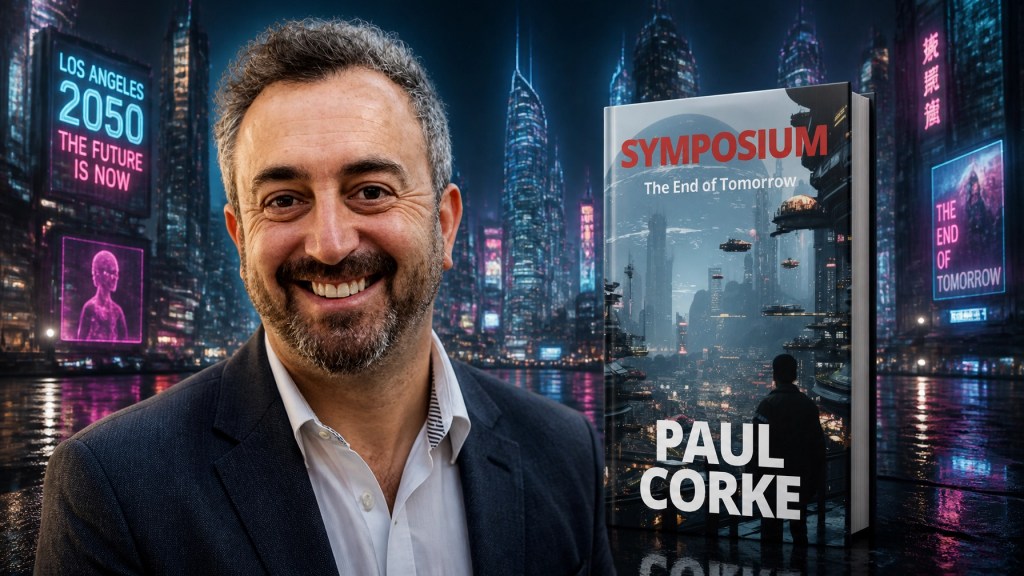
When I sat down to write Symposium: The End of Tomorrow, I wanted to move away from the “us vs. them” narrative. We live in a world where technology is becoming an extension of our bodies and minds. Alan and AL aren’t two separate entities fighting for dominance; they are two sides of the same coin.
I’ve always been fascinated by how we use technology to hide from ourselves, and conversely, how it occasionally forces us to look closer. If you’re a fan of sci-fi that makes you look at your smartphone a little differently, this book is for you.
Conclusion: Are You Ready to Look in the Mirror?
The future isn’t a robot war. It’s a reflection.
As we move through 2026 and head toward the world of 2050, we have to decide what kind of image we want to project. Are we going to build AIs that reflect our best traits: our curiosity, our kindness, and our resilience? Or are we going to keep feeding the mirror our fears until the reflection becomes a monster?
Symposium: The End of Tomorrow is more than just a thriller; it’s a preview of the choice we’re all making right now.
If you’re looking for your next obsession, dive into the neon-lit streets of 2050 LA. See the world through Alan’s eyes: and see what’s looking back from the other side.
Ready to join the Symposium?
Explore the origin story of mankind and the future of AI in Symposium: The End of Tomorrow by Paul Corke.
Get your copy today and discover why readers are calling it one of the best sci-fi books of the year.

Leave a comment