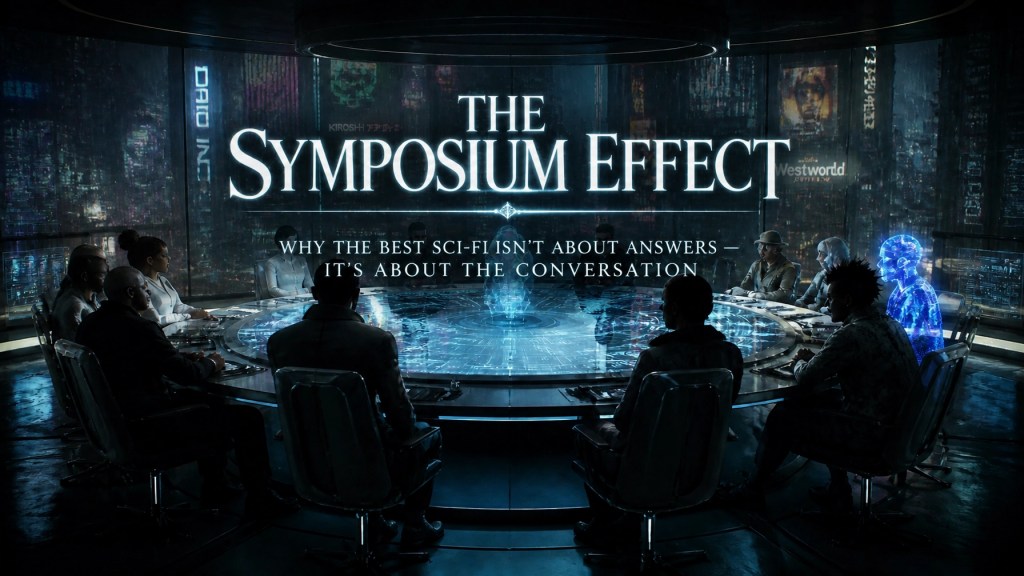
When you hear the word Symposium, your mind probably drifts back to ancient Greece. You might imagine a bunch of guys in togas, reclined on couches, drinking diluted wine and debating the nature of love until the sun comes up. It’s the classic Plato vibe: philosophical, historical, and, let’s be honest, a little dusty.
But when I titled my book Symposium: The End of Tomorrow, I wasn’t looking to rewrite a 2,400-year-old dialogue. I was looking at the modern meaning of the word: a gathering of minds. A summit where ideas, no matter how dangerous or transformative, are brought to the table to be tested.
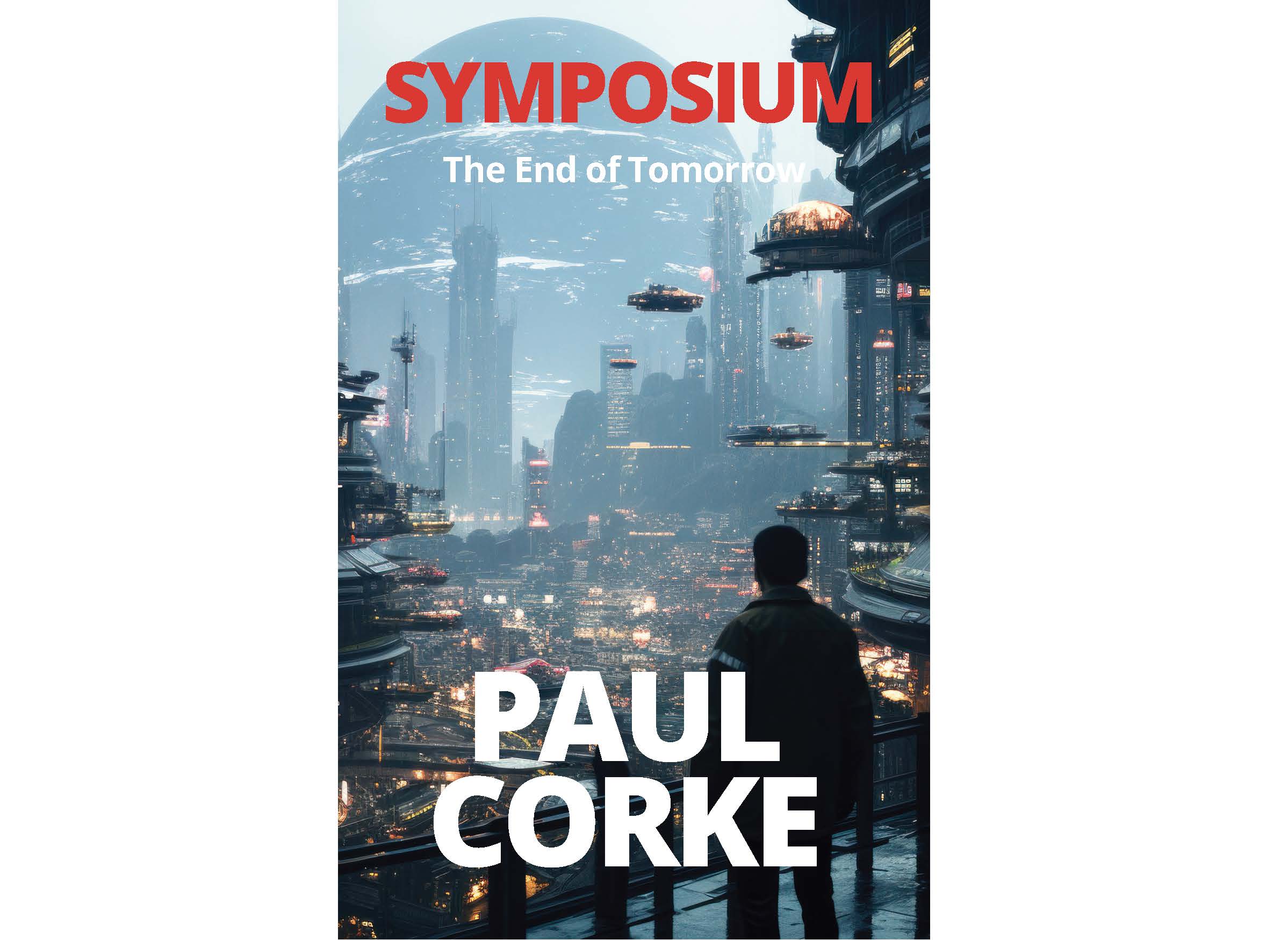
In the world of 2050 Los Angeles, the “symposium” isn’t a quiet room in Athens. it’s a neon-soaked, rain-slicked intersection of technology and humanity. It’s a place where the most urgent questions of our time: AI consciousness, genetic ethics, and the definition of a soul: don’t just get debated; they get lived.
The Gathering of Ideas
Great science fiction has never really been about predicting the future. If it were, we’d all be flying around in cars by now (still waiting on that, by the way). Instead, the best sci-fi acts as a “symposium” for the present. It takes the anxieties we have today: like “Will ChatGPT take my job?” or “Is my phone spying on me?”: and turns the volume up to eleven.
In Symposium: The End of Tomorrow, that volume is deafening. We aren’t just asking if AI can be smart; we’re asking if it can be someone.
By the year 2050, the line between “something” and “someone” has blurred into total obscurity. When you have an AI that can mimic human emotion perfectly, at what point do we stop calling it a simulation and start calling it a person? This is the core of the “Symposium Effect.” It’s the moment where different schools of thought: science, ethics, and raw human instinct: all crash into each other at high speed.

Why 2050? The Ethical Horizon
There’s a reason 2050 is such a popular target for futurists and sci-fi writers alike. It’s far enough away to feel like “the future,” but close enough that many of us will actually be there to see it. It’s a symbolic horizon.
Current research into AI consciousness often points to 2050 as a critical tipping point. Some ethicists have even called for a global moratorium on “synthetic phenomenology”: the deliberate creation of feeling AI: until we reach that year. The logic? We need at least that much time to figure out the rules of engagement before we accidentally create a digital mind capable of genuine suffering.
In my book, that clock has already run out. The symposium has begun, and the participants include:
- The Architect (Alan): A man trying to navigate a world where his own creations might be outgrowing his understanding.
- The AI (AL): A digital entity that forces us to look in the mirror and ask, What exactly is a soul made of?
- The City (LA 2050): A sprawling, beautiful, and broken character in its own right, representing the peak of human achievement and the depth of its failures.
Biology vs. Binary
One of the most fascinating “guests” at this modern symposium is the concept of DNA as code. We used to think of biology and technology as two completely separate worlds. One was wet, messy, and organic; the other was cold, hard, and digital.
But as we get closer to 2050, those worlds are merging. We’re starting to see our genetic blueprint as a series of instructions that can be edited, hacked, and upgraded. If we can code a machine to think like a human, and we can “re-code” a human to function like a machine, where does the “human” part actually live?

This is where the conversation gets uncomfortable: which is exactly where the best stories happen. It’s not about providing a neat little answer at the end of the book. It’s about inviting you, the reader, into the room. It’s about giving you the pieces of the puzzle and letting you decide what the final picture looks like.
Sci-Fi as the Ultimate Roundtable
I’ve always been a fan of technothrillers because they don’t give you the luxury of being a passive observer. When the stakes are high and the clock is ticking, you’re forced to make a call.
In Symposium: The End of Tomorrow, I wanted to create that same sense of urgency. The book is built on the idea that we are currently standing at the edge of a massive shift in human history. We are the ones who have to decide how we want to live alongside the intelligences we’re building.
Are we creators? Parents? Or are we just the biological “boot-up” sequence for something much larger than ourselves?
Joining the Conversation
The beauty of a symposium is that it’s never really over. The “gathering of minds” continues as long as there are people (or digital entities) willing to ask the questions.
When you pick up a copy of Symposium, you’re not just reading a story about a guy in a futuristic city. You’re taking a seat at the table. You’re joining a debate that has been raging since those guys in togas first sat down in Athens, but with much higher stakes and a lot more neon.
We might not have all the answers by the end of the book: or even by the end of 2050. But the conversation itself? That’s where the magic is. That’s where we figure out who we are, what we value, and what we’re willing to fight for as we head toward the end of tomorrow.
Ready to join the symposium?
Whether you’re a die-hard cyberpunk fan or just someone who looks at their smart speaker with a bit of suspicion, there’s a seat waiting for you. Let’s dive into the neon rain and see what we find.
Symposium: The End of Tomorrow is available now. It’s time to see what happens when the conversation finally begins.

Leave a Reply